Categories
Arctic Change

Long-term Data Collection Serves Many

Drew Sauve (standing) and Thomas Leicester set up a noose mat near a roost site in August, the rainiest month of the field season. Image Credit: Drew Sauve

The Black Guillemots on Cooper Island are one of many wild populations that are responding to climate change by changing when they lay their eggs. These Arctic seabirds want to lay their eggs as soon as the winter snow melts and spring begins, because their breeding season—from first access to a nest cavity to departure of chicks—is 80 days, an exceptionally long breeding period for a bird. Parent guillemots have to have their young ready to fly off to sea before fall snow accumulation begins to block entrances to nest cavities. In recent years, with sea ice retreating offshore in late summer, early breeding has the benefit of being able to provision young when the preferred prey of Arctic Cod is still readily available.

While there are decades of data that show spring snowmelt is occurring earlier in northern Alaska and, allowing guillemots to lay their eggs earlier, my research is focused on whether Black Guillemots are evolving to lay their eggs earlier.

George has created a detailed banding dataset, where every parent has a numbered metal band, and a unique colour band combination; all of their nestlings are banded before fledging. Using this data set, I can construct family trees for the birds breeding on the island. Family trees or pedigrees are often used in studies of human health or livestock breeding. In the rare case where we have long-term pedigrees in wild populations, geneticists can use them to determine genetic variation in a trait—in this case, when birds lay their eggs.

Pedigree
This visualization represents thee pedigree of Black Guillemots on Cooper Island. Blue lines link fathers to offspring and red lines like mothers to offspring. Each row is a generation of guillemots; each line lines a parent at the top and an offspring on the bottom. Individuals on the last row would belong to the 6thgeneration of guillemots on Cooper Island and have a great-great-great-great grandparent in the data set. Image credit: R package ‘pedantics’.

The amount of genetic variation or the potential for genetic change in a key trait like egg-laying date could determine whether a population will be able to adapt to climate change.

The analyses we do with a pedigree are similar to what a farmer might do when trying to select cows that produce more milk. Some cows and their families might produce more milk, so the farmer would select those cows when breeding their stock. Instead of cow families that produce lots of milk, I tried to find guillemot families that laid their eggs earlier than others in response to snowmelt. However, instead of a farmer selecting cows I wanted to see if climate change was selecting for earlier breeding guillemots.

Ultimately, there were no family groups that tended to lay earlier than others. Using my farmer example again, this would be like trying to select a cow with high milk output when all the families of cows produced the same amount of milk. The farmer would be unable to improve their herd because all the cows are the same with regards to milk production.

What this means on Cooper Island is that Black Guillemots are unlikely to evolve earlier laying dates to match warmer temperatures and the change in laying-date we’ve observed so far is not because of evolution. Rather individual birds are behaviorally adjusting their laying date due to changes in snowmelt.

Unfortunately, this behavioural response to snowmelt doesn’t seem to be enough of a response as the birds are still struggling to raise offspring in the warming Arctic.

The Cooper Island data demonstrate the power of long-term, detailed data collection. Just as George did not intend to study climate change when he started the study in 1975, I also do not think he intended on collecting data that one day would be useful for building a pedigree with multiple generations of Black Guillemots, but he did just that.

The value of long-term datasets might not always be apparent when starting the study, but much of our understanding of evolution, behavior, ecology, and responses to climate change come from research that span decades. I suspect that the Cooper Island dataset and others like it will continue to be valuable in the future.


cooper crewPhotoshopped-2
Drew Sauve

Drew Sauve just finished his master’s with the Friesen Lab at Queen’s University, Canada and is starting a doctorate in September 2018 with Vicki Friesen and Anne Charmantier using the Cooper Island dataset to determine whether climate change is causing evolutionary change in chick growth. Drew is interested in evolution, ecology, genetics, and the responses of individuals and populations to environmental change.


This field report is part of an ongoing series titled Arctic Change centered around George Divoky’s 44th field season studying Black Guillemots, sea ice, and climate change on a remote Arctic island off the coast of Alaska. To donate and support Divoky’s work on Cooper Island, visit the Friends of Cooper Island website.


Categories
Arctic Change

Hatched!

A parent brings Arctic cod to their hungry chick waiting at the nest. Image Credit: George Divoky

Hatching is finally over with one very late egg hatching today after having been incubated for 34 days; 28 days is normal.  The oldest nestling is 16 days old; the chick is gaining weight and doing well like all of the other 45 nestlings.

While the main pack ice is well offshore, the Marginal Ice Zone, where ice covers from 18 to 80 percent of the ocean’s surface, extends south to the entire Alaskan Beaufort Sea coast, including Cooper Island. The seascape visible from the north beach now has widely scattered floes, some with rather high vertical relief breaking the horizon, in a nearly flat calm sea. This differs greatly from what was present last year when the first week in August had no ice visible with large swells breaking on north beach. More importantly, last year at this time the sea surface temperature was well above 4 degrees Celsius while this year it is less than 2 degrees Celsius. The guillemot’s preferred prey, Arctic Cod, are typically found in waters from -2 to 4 degrees.

Labeled
A Multisensor Analyzed Sea Ice Extent (MAISE) image shows why George is seeing ice off of Cooper Island. Image Credit: National Snow and Ice Data Center (NSIDC)

The ice and water temperature conditions are ideal for the parent birds provisioning. Arctic Cod has comprised well over 90 percent of the prey being fed to chicks this year. The two oldest chicks, hatched on July 21, weighed 35 grams at hatching and now weigh 275 grams and 245 grams – the larger of the two experiencing an almost seven-fold weight increase in a 15-day period. A growth rate that rapid requires readily available prey that is both abundant and high energy, as well as two dedicated parents to return to the nest site with a fish every hour. Similar high growth rates are occurring at other nests.

This condition of the nestlings could not be more of a contrast with early August last year. Then, there was widespread mortality of younger siblings as parents could only find enough prey to maintain a single nestling. Arctic cod were absent for much of the nestling period with sculpin and juvenile sand lance comprising most of the prey. Guillemot parents turn to these alternative prey only when Arctic Cod are not available.  Sculpin, with their large bony and spiny heads, are hard for nestlings to hold and swallow. They are frequently rejected with numbers building up in nest sites as the young wait for a more preferable fish.

Blob sculpin, bony fish guillemot chicks struggle to consume, lay uneaten in a nest case. Image credit: George Divoky

For the moment our daily nest weighing and measuring of guillemot nestlings has been a very positive experience. However, based on what we have seen in the last decade, we know that conditions can change rapidly in August. A strong south wind could move the ice well out of the guillemots’ foraging range or warmer waters could move eastward from the Chukchi and drive away Arctic Cod. We also know that larger and older nestlings are more able to survive changes in prey availability and that the current high growth rates will allow more individuals to survive to fledging.

This post was updated on August 11.

This field report is part of an ongoing series titled Arctic Change centered around George Divoky’s 44th field season studying Black Guillemots, sea ice, and climate change on a remote Arctic island off the coast of Alaska. To donate and support Divoky’s work on Cooper Island, visit the Friends of Cooper Island website.


Read more

Alaskan Black Guillemots Fight Ice Retreat by

Energetic Value of Prey Species Utilized by Black Guillemots (Cepphus grylle) on Cooper Island, an Arctic Barrier Island by Ann Robertson et al.
Categories
Arctic Change

Soggy Fieldwork


2012 Chicks
Cooper Island chicks in 2012. Image Credit: George Divoky

August is the rainy month of our field season, and the first day of the month was tough for us. During our morning nest checks, it wasn’t easy to keep our hands warm in a steady soaking rain, coupled with a windchill of 27 degrees Fahrenheit.

The fingerless gloves I wear daily in the summer are a godsend for handling eggs and nestlings–wet fingerless gloves at temperatures near freezing are only slightly better than no gloves at all.

NanukCase2015
George collecting data at nesting case in 2015; the cases were added once polar bears became regular visits on the island. Image Credit: George Divoky

The cold, wind and rain (and numb fingers) were made more bearable by the fact that our nest checks found hatching high at nests that are still being attended. All the chicks seem to be doing well in their first few days.

After hatching, guillemot nestlings are incubated by their parents for about a week. The parent’s defeathered brood patch (present in both males and female parents) warmed the egg for the last month and now provides heat to the nestlings, reducing their caloric needs.

In a breeding season where good news about the Cooper Island guillemot colony is at a premium, there are a good number of nestlings being warmed by their parents in the remaining active nests. Nearly 40 chicks are currently in the colony with a few more eggs expected to hatch soon. While overall hatching success will be low with so many nests having eggs abandoned shortly after laying, hatching success for nests that have been regularly attended will be high.

Given the high overwinter adult mortality and decrease in pairs and number of birds that did not lay or incubate eggs, this has not been a good year for the colony.  But that does not mean it is a bad year for all pairs – and focusing on the success of individual nests provides a sense of optimism.

Some parents will be able to fledge one or even two chicks this year, though it will certainly not be as easy as it was for parents breeding here in the 70s and 80s when sea ice was just offshore and prey abundant. The nestlings hatching now (at 35 grams) will have to undergo a 10-fold increase in weight before flying off after five weeks of being fed by their parents. Their growth and survival will depend on the abundance and availability of fish in the adjacent Arctic Ocean.

August has always been the month when the warming Arctic has had the most effect on the productivity of the Cooper Island Black Guillemot colony. We are hoping conditions this August will allow many of the newly hatched chicks to be flying out to sea later this month – and returning in a few years to breed and maintain the colony.


This field report is part of an ongoing series titled Arctic Change centered around George Divoky’s 44th field season studying Black Guillemots, sea ice, and climate change on a remote Arctic island off the coast of Alaska. To donate and support Divoky’s work on Cooper Island, visit the Friends of Cooper Island website.


Field Team Update

cooper crewPhotoshopped-2
Drew Sauve

Drew Sauve and Thomas Leicester arrived on the island on July 22.

Drew completed a master’s at Queen’s University in Kingston Ontario this past spring analyzing heritability and plasticity in timing of egg laying in the Cooper Island Black Guillemots.  He is continuing for a doctorate that expands on his master’s and includes genetic analysis of the individuals breeding on Cooper. Our daily fieldwork includes collecting feathers and other tissue for him to analyze in the lab.

Thomas is an undergraduate I met through my collaboration with Kyle Elliott of McGill University. This is Thomas’s first ornithological fieldwork and it’s been enjoyable to explain the data gathering techniques and what the data sets tell us about both the guillemots and the Arctic environment.

Thomas Leicester

Having Drew and Thomas on the island has provided the personnel needed to capture more birds as they roost next to the pond in the middle of the colony. Using mats with monofilament nooses we have been able to catch and give color bands to 20 birds that fledged from Cooper Island but have yet to join the breeding population. Two of these birds were nest mates in 2015, fledging from nest I-7, which their male parent still occupies, alone because their female parent was one of the birds that died this past winter. She has not been replaced by a new recruit this year.

– George


Categories
Arctic Change

Loss and Brief Moments of Hope

Cooper Island Black Guillemot in May 2017. Image Credit: George Divoky

Nature, when observed or monitored for any extended period, typically provides a predictability that is reassuring in its consistency and sufficient surprises to keep one engaged.

For over four decades, my first task after I set up camp was a census of the Cooper Island Black Guillemot colony. This year was an excellent example of this balance of the expected and unexpected.

Banded
Colorful bands make it easy to identify familiar birds and newcomers (without bands). Image Credit: George Divoky

Since the 1970s, the majority of the birds breeding in the colony have had, in addition to a numbered metal band, a unique combination of color bands allowing identification with binoculars of individual birds. My census of the colony consists of recording the number of occupied nest sites and the color band combinations of the individuals occupying each site. This allows me to determine the birds who survived the winter since last year’s breeding season and whether they have retained the same nest site and mate.

Black Guillemots, like most seabirds, have high annual survival of adult birds and high mate and nest-site fidelity. On average 90 percent of the individuals breeding on Cooper have returned the following year with mate and nest-site fidelity over 95 percent. With loss of breeding birds so uncommon and changes in mate and nest site so rare, past censuses consisted primarily of confirming last year’s pair was again occupying a particular nest site. For the small number of nests where one member of a pair did not return, there typically was a new recruit already occupying the vacancy by the time of my census–either a bird banded as a nestling on Cooper Island or an immigrant, indicated by its lack of any bands.

In the past, the high survivorship of breeding birds meant that some of the individuals I resighted each June were ones I had seen for over 20 years, and in many cases had known since I had weighed them daily as a nestling. The resightings of these individuals as adults provided an annual touchstone that was an important part of both my emotional and scientific connection to the colony.

My initial census of the colony this year was unlike any in the past. The loss of breeding birds over the winter was the highest on record. Nearly one-third of the 170 birds that bred in 2017 not returning to the colony in 2018.

As mentioned in an earlier post, many of the 50 pairs that had eggs this year (down from 85 in 2017 and 100 in 2016) consisted of widowed birds that both lost a mate over the winter. The decrease in breeding population was exacerbated by the paucity of previously nonbreeding birds present to recruit into the breeding population. Some established breeders widowed over the winter are the sole occupants of their nest sites. Even pairs that did survive the winter have shown much lower mate and site fidelity than I have observed in previous years.

The disturbingly high percentage of birds lost to overwinter mortality comes as a major surprise but a simple percentage fails to capture the full impact of what I experienced during this year’s census.

Screen Shot 2018-05-18 at 1.36.12 PM
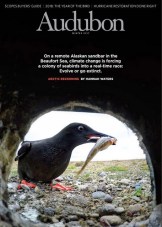
George’s “Cover Girl,” featured here on a December cover of Audubon Magazine, didn’t return to Cooper Island this year. Image Credit: Peter Mather for Audubon

Many of the individual birds I have known for decades were among those absent from the colony. Most notable was Yellow-Gray- Green, a 21-year-old female banded as a chick in 1996 and breeding on Cooper since 2001. She was featured on the cover of last winter’s Audubon magazine. Another individual absent this year with an even longer history on the island is White-Gray-Blue, who fledged from Cooper in 1989 and bred on the island during 23 years of rapid environmental change including of decreases in sea ice, warming ocean temperatures, increased polar bear nest predation and major shifts in prey availability.

While examining this year’s colony census at the level of the individual bird, versus a review of declining numbers is disheartening, it also provides some reasons for optimism–a rare feeling this field season.

My census found that a number of birds fledged from Cooper in recent years recruited into the breeding population this year, starting what I hope will be a long and productive career as breeders. These birds, and their young–the fledging chicks we hope they produce later this summer–provides one both with optimism and motivation to maintain the long-term study. As Hannah Waters pointed out in her excellent article in Audubon magazine, the guillemots are going to have to adapt and evolve for the colony to survive in a rapidly warming Arctic.

The hope that this year’s first-time breeders and their young will find a way to maintain the colony during the major changes occurring in the Arctic allows me to maintain a positive attitude as I continue to monitor this year’s breeding season.


This field report is part of an ongoing series titled Arctic Change centered around George Divoky’s 44th field season studying Black Guillemots, sea ice, and climate change on a remote Arctic island off the coast of Alaska. To donate and support Divoky’s work on Cooper Island, visit the Friends of Cooper Island website.


Read more

Can These Seabirds Adapt Fast Enough to Survive a Melting Arctic? by Hannah Waters

Arctic Worries by Jenny Woodman

George Divoky’s Planet by Darcy Frey


Categories
Arctic Change

Arctic Worries

George Divoky frets–with good reason. In 2016, CNN Correspondent John D. Sutter called him the man who is watching the world melt. The description is as distressing as it is apt.

George sends us regular dispatches from a small field camp on Cooper Island, about 25 miles east of Utqiaġvik, where he has studied a colony of nesting Mandt’s Black Guillemots for the last 44 years. Since his work began in 1975, the research has morphed into one of the longest-running studies of seabirds, sea ice, and climate change.

Guillemots look like small penguins headed off to a fancy party replete with ice sculptures and all-night dancing. Unlike other seabirds that migrate out of the region seasonally, they live out over the frigid waters year-round, only returning to land to breed and fledge their young–this makes them an excellent indicator of how climate change is impacting the Arctic.

Weather delayed the start of this research season in early June. While warm temperatures in the Arctic have made headlines in recent months, unusually late snow and ice kept the guillemots from reaching their nesting boxes until mid-June; the first egg was laid on June 24.

His communications are tinged with an effort to buoy spirits–I’m guessing his own more so than ours. This week, the bad news came first: a 29-year-old female died. He wrote that she had been banded during the first George Bush administration. (While many humans rely on a simple Gregorian calendar, George’s memories appear to be synchronized according to a timeline rooted firmly in geopolitics.)

Bad news was followed with happy; two siblings from the 2014 cohort returned and recruited partners for breeding.

Otherwise, it’s been a stormy week on the island. On July 20, he wrote that the wind was finally dying down. A bad week for the infrastructure, the camp’s weather station was blown over and part of the heavy-duty WeatherPort tarp separated from the frame, which caused a number of things to get wet. On Wednesday he saw record high rainfall for that date.

Egg laying hit an all-time low this year, with fewer breeding pairs than any previous year.

He’s asking questions about how changing ice conditions will impact these seabirds – his seabirds. In his most recent field report, he spoke at length about the relationship between the guillemots and nearshore sea ice. The location of the sea ice impacts how far parents will have to fly to access suitable prey for their chicks. Increased travel time means greater energy expended by parents – for seabirds that live predominantly out in open waters, it’s all about balancing resources and energy. The presence or absence of sea ice combined with the temperature of the ocean waters impacts the availability of Arctic Cod, the small nutritious fish the guillemots prefer.

George hopes the slowly departing nearshore sea ice will keep ideal prey in foraging range for the seabirds. He wrote, the cod is “urgently needed for the colony to reduce its current population decline.”

David Douglas is a research wildlife biologist for United States Geological Survey (USGS) Alaska Science Center; he and George are frequent collaborators. This week he emailed the MODIS images displayed above and wrote that Cooper Island was pretty well surrounded until July 16 when the persistent ice immediately around the island broke up and melted.

Studies like George’s will help scientists to better understand the ramifications of long-term warming and less sea ice for wildlife in the region. Impacts to wildlife will directly affect the lives of the people who depend on subsistence fishing and hunting for survival.

Warming Arctic conditions have persisted with 2018 reaching record lows for sea ice extent, according to a report published by NOAA and University of Alaska Fairbanks’s International Arctic Research Center.

Late ice formation and early retreat in the Chukchi and Bering Seas impacted local communities by making travel for subsistence hunting and fishing dangerous and, at times, impossible. Storm damage and erosion was worsened by exposed shorelines, left unprotected by a lack of sea ice. Island villages and coastal communities experienced flooding and property damage as well. You can read more about the storm impacts here and here.

The report attributes late and minimal ice coverage to warmer temperatures, particularly over the last four years. Increased temperatures combined with stronger storms helped break up weaker ice.

In 2018, there was less sea ice in the Bering Sea than any year since 1850, when commercial whalers began recording this data. Experts agree, loss of sea ice is a result of climate change. Continued warming creates a feedback loop where warming temperatures melt ice; without a reflective snow and ice covering, the ocean absorbs more of the sun’s warming rays and temperatures continue to rise.

sea-ice
Sea ice since 1850. Image Credit: NOAA and University of Alaska Fairbanks International Arctic Research Center (UAF-IARC).

As for future winters, what can people expect to see if warming continues at current rates?

“Communities need to prepare for more winters with low sea ice and stormy conditions. Although not every winter will be like this one,” concludes the report, “there will likely be similar winters in the future. Ice formation will likely remain low if warm water temperatures in the Bering Sea continue.”

And for George’s seabirds? How many birds will successfully fledge this year? How many will return next?

We’ll just have to wait and see.


This piece is part of an ongoing series titled Arctic Change centered around George Divoky’s 44th field season studying Black Guillemots, sea ice, and climate change on a remote Arctic island off the coast of Alaska. To donate and support Divoky’s work on Cooper Island, visit the Friends of Cooper Island website.


Read More

Historic Low Sea Ice in the Bering Sea by Kathryn Hansen for NASA Earth Observatory

Arctic Sea Ice a Major Determinant in Mandt’s Black Guillemot Movement and Distribution During Non-Breeding Season By G. J. Divoky, D.C. Douglas, and I.J. Stenhouse

Melting Arctic Sends a Message: Climate Change Is Here In a Big Way by Mark Serreze

The First Frontier: Creating a Climate Displacement Fund for Displaced Alaska Communities By Wen Hoe

Categories
Arctic Change

Seabirds and Sea Ice

MODIS June
MODIS image from June 5; snow and ice have blue/cyan color, while clouds will be lighter gray/white. Image Credit: David Douglass/USGS

Over most of its range the Black Guillemot is a nearshore seabird, occupying coastal waters during both the breeding and nonbreeding seasons, as do other members of the genus Cepphus. Pelagic or open ocean waters can offer abundant prey resources, but these options are often distant, patchy and unpredictable.

The nearshore typically offers seabirds a smaller but more reliable source prey base consisting of forage fish and benthic fauna from the ocean floor such as crustaceans or mussels.

The Arctic Ocean has extensive sea ice cover in the nearshore for the majority of the year; this presents a number of challenges to a nearshore species. Our work on the Cooper Island Black Guillemots has revealed a number of ways in which the species has met these challenges.

The current view from my cabin window illustrates one of the major problems guillemots face in the Arctic. Sea ice extends from the north beach of the island to the horizon and covers Elson Lagoon to the south. The only water available to the guillemots is a brackish pond in the center of the colony that provides no prey but is deep enough to provide sanctuary if the guillemots need to dive when pursued by an owl or falcon — regular visitors to the island.

MODIS July
MODIS image from July 9; snow and ice have blue/cyan color, while clouds will be lighter gray/white. Image Credit: David Douglass/USGS

While guillemots arrived on the island almost a month ago and egg laying is now complete, until recently the closest predictable open water where guillemots could find prey was approximately 20 miles away, off Point Barrow where winds and currents shift the sea ice creating an area of open water. This opening is called a lead. The Cooper Island guillemots stage there in April and May before coming to the island. (Editor’s note: Leads are important for wildlife, because they allow for access to oxygen in the case of seals and walruses and prey in the case of seabirds; you can read more from the National Snow and Ice Data Center here.)

This distance between the Cooper Island guillemots’ nesting colony and access to their prey resources during egg laying and incubation is in sharp contrast to what guillemots breeding in subarctic or temperate waters find at their breeding colonies. These birds occupy waters directly adjacent to colonies well before egg laying and foraging areas may even be within sight of nests. The birds breeding on Cooper Island (and likely all colonies of Mandt’s Black Guillemot Cepphus grylle mandti, the high Arctic subspecies of Black Guillemot) have responded to this spatial disconnect by having a well-defined periodicity in their daily colony attendance. Every day, the parent not incubating eggs and all nonbreeding individuals vacate the colony from approximately noon until midnight. The birds fly individually or in small groups to open water where they can feed for almost half the day before returning to the colony just as the “midnight sun” is at its lowest point in the sky.

BeachwCases 2015
Cooper Island beach with nesting boxes from 2015. Image Credit: George Divoky

While it seems individual birds could fly offshore to open water to feed anytime during the day, there are a number of possible reasons the observed colony-wide pattern of attendance and abandonment developed. For the half of the day when the guillemots are absent – from approximately noon to midnight – there is no evidence that Cooper Island supports a colony of Black Guillemots. It appears to be just a barren sandbar that happens to inexplicably have 200 scattered black plastic cases along with a small cabin surrounded by a bear fence. Falcons, Snowy Owls, and other predators moving along the barrier islands would have little reason to be attracted to this place.

The timing of the birds’ departure and return may be related to changes in air temperature and its effect on ice formation. On nights when the air temperature is below freezing (as it was last night), I have frequently observed the formation of new ice on the surface of the few spaces of open water in the sea ice directly adjacent to shore. This newly formed ice melts in the morning as air temperatures rise. Nocturnal formation of new ice in the waters adjacent to the pack ice reduces the amount of open water available for guillemots to dive for the prey.

This temporary daily reduction in foraging area could be expected to have been pronounced during the Last Glacial Maximum when air temperatures were lower and the ancestors of the Cooper Island guillemots occupied an Arctic refugium. The current pattern of colony attendance for the Cooper Island colony – foraging during the warmest part of the day and attending the breeding colony at night – could have evolved as a way of maximizing the amount of open water available for guillemots.

The large expanse of shorefast ice north of the island this year is persisting later than expected compared to recent years. While the nearshore ice may now be forcing the Cooper Island guillemots to fly further in search of prey, it could benefit the colony later this summer should ice remain in the nearshore close to the colony. In recent years a lack of sea ice when the guillemots are feeding young resulted in increased nestling mortality as higher sea surface temperatures reduced the availability of Arctic Cod, the guillemots’ preferred prey.

Should this year’s nearshore ice break up slowly over the next month, Arctic Cod could remain in the guillemots’ foraging range and allow increased chick growth and fledging success. The latter is urgently needed for the colony to reduce its current population decline. First eggs will be hatching in about two weeks and our daily weighing of nestlings and prey observations should demonstrate how much this year’s persistent sea ice has affected the guillemots’ nearshore environment.


This field report is part of an ongoing series titled Arctic Change centered around George Divoky’s 44th field season studying Black Guillemots, sea ice, and climate change on a remote Arctic island off the coast of Alaska. To donate and support Divoky’s work on Cooper Island, visit the Friends of Cooper Island website.


Read more

Arctic Sea Ice a Major Determinant in Mandt’s Black Guillemot Movement and Distribution During Non-Breeding Season by G. J. Divoky, D. C. Douglas, I. J. Stenhouse

All About Sea Ice by National Snow and Ice Data Center

Summertime and the Sea Ice is Leaving by Jenny Woodman

Take the A-Train to the Arctic by Jenny Woodman


.


Categories
Arctic Change

Long-term Decline Accelerates in Arctic

NanukCase2015
George collecting data at nesting case in 2015; the cases were added once polar bears became regular visits on the island. Image Credit: George Divoky

The Cooper Island Black Guillemot colony experiences a major decrease in breeding pairs as long-term decline accelerates.

As of July 6, egg laying ended at the Cooper Island colony and the number of breeding pairs is the lowest it has been in four decades. Only 50 guillemot pairs have laid eggs, down from 85 pairs last year, 100 pairs in 2016 and 200 pairs in the late 1980s.

Screen Shot 2018-07-15 at 9.20.57 AM
Cooper Island breeding pairs over the years; it is important to note that the number of available sites has not decreased as the population has decreased, meaning some environmental factor has likely been decreasing the population. Image Credit: Jenny Woodman

A primary reason for the decline was increased overwinter mortality, with almost one third of the last year’s breeders failing to return to the colony. The long-term average for overwinter mortality is ten percent. Also contributing to the decline was a paucity of recruits to occupy the vacancies created by the mortality. Many of this year’s pairs are composed of two birds that lost mates over the winter. All recruitment that did occur were of birds that had fledged from Cooper Island. Immigrants used to constitute the majority of birds recruited into the breeding population.

A potential reason for the high mortality is the lack of sea ice in the area traditionally occupied by Cooper Island guillemots in winter. The unprecedented lack of sea ice over the Bering Sea shelf likely forced birds to occupy the ice edge in the Arctic Basin north of the Bering Strait, where prey resources may not be as abundant.

The 15 geolocators recently removed from returning birds will allow determination of the winter distribution.

The number of breeding pairs also declined due to the number of pairs maintaining nest sites but failing to lay eggs. Nonbreeding by experienced birds and established pairs has been extremely rare on Cooper Island but this year there are 20 such pairs. The presence of such birds, unable to initiate clutches after occupying a nest site, is an indication that overwinter or spring conditions caused both a decrease in the condition of returning birds as well as increased mortality.

Eggs will begin hatching in the third week of July and one has to hope fledging success will be high.


This field report is part of an ongoing series titled Arctic Change centered around George Divoky’s 44th field season studying Black Guillemots, sea ice, and climate change on a remote Arctic island off the coast of Alaska. To donate and support Divoky’s work on Cooper Island, visit the Friends of Cooper Island website.


Read more

The Earliest Year by George Divoky

Summertime and the Sea Ice is Leaving by Jenny Woodman

In the Arctic, the Old Ice Is Disappearing by Jeremy White and Kendra Pierre-Louis (2018)

Sea Ice by Michon Scott and Kathryn Hansen for NASA Earth Observatory

Categories
Arctic Change

Work Worth Doing

G. Divoky at BG-1 1972
George Divoky in the field at the first Black Guillemot nest site discovered on Cooper Island in 1972. Image Credit: George Divoky

The Cooper Island Black Guillemot study was recently mentioned in an Associated Press story by Seth Borenstein about researchers who “accidentally” began studying climate change. A number of scientists measuring a biological phenomenon have encountered unanticipated effects from climate change and understood those effects were more important, both biologically and politically, than what originally motivated them to initiate their research. The 44-year Cooper Island study has undergone a number of changes before its current focus on assessing the decadal effects of Arctic warming on seabirds.

When I first landed on Cooper Island in 1975, I had no intention of studying climate change or global warming.

Neither the globe nor the Arctic had warmed in the decades immediately preceding the start of my study. Research at the Cooper Island Black Guillemot colony started as part of a large federal program assessing Alaska’s then largely unknown marine ecosystems in anticipation of leasing offshore waters for oil development. Cooper Island was the furthest north of many seabird colonies in coastal Alaska where biologists documented the extent and basic biology of the state’s seabird resources in the late 1970s. When that program ended in 1981, due to a change of administrations and a less urgent need to move forward with offshore drilling, it had provided sufficient information for the drafting of environmental impact statements.

In 1982, lacking federal funding, and possibly more importantly logistical support, I made the decision to return to Cooper Island to continue the Black Guillemot study. I had developed a real attachment to northern Alaska with its field seasons of 24 hours of daylight and sea ice always visible just offshore. Through annual banding of breeding birds and their nestlings in the late 1970s, I had developed a population of largely known-history and known-age seabirds. I was initially drawn to the study of seabirds having read the works of British ornithologists conducting multi-year studies at a single colony and documenting the life histories of individual birds. Such work is beyond the scope and timeframe of pre-development environmental assessments and of federal agencies, with their frequently shifting agendas.

Only in the third decade of research was there an indication that increasing atmospheric temperatures were affecting the Black Guillemot colony. Earlier snowmelt in the 1990s allowed earlier initiation of breeding. Climate change impacts rapidly increased in the 21st Century as decreasing sea ice and increasing sea surface temperatures reduced the guillemots’ preferred prey and greatly reduced breeding success. The least nuanced sign of Arctic warming, polar bears stranded on the island approaching our field camp, began in 2002 and this will certainly occur again this summer.

While monitoring the effects of climate change will continue to be the focus of the work, the study is now proceeding in ways never anticipated in 1975. Since 2011, we have deployed biologgers on the bands of guillemots to measure diving behavior during breeding and location and activity of birds during the nonbreeding season. That work is being continued and analyzed as part of the Sentinels of Sea Ice (SENSEI) project, which this fall will have our collaborators from France’s National Center for Scientific Research (CNRS) hiring a post-doc to examine our demographic database.

Vicki Friesen of Queen’s University in Kingston, Ontario has a graduate student, Drew Sauve, examining the genetics of individual guillemots and the heritability of the metrics we have obtained on breeding biology.  Drew recently completed a master’s degree on the heritability of timing of egg laying and is beginning a doctoral program utilizing the Cooper Island colony and database. He will be joining me on the island later this month to gather additional genetic material.

As I walked around the colony this past week in this 44th year of the study, determining nest ownership and dates of egg laying, it is extremely satisfying to know the data is part of a data set spanning six generations of guillemots and can provide unparalleled insights into the biology of an Arctic seabird experiencing a rapidly changing environment.


This field report is part of an ongoing series titled Arctic Change centered around George Divoky’s 44th field season studying Black Guillemots, sea ice, and climate change on a remote Arctic island off the coast of Alaska. To donate and support Divoky’s work on Cooper Island, visit the Friends of Cooper Island.


Read more

Alaska’s North Slope Snow-Free Season is Lengthening from University of Colorado Boulder

Exit, Pursued by Bear by George Divoky

Categories
Arctic Change

Seabird Update

nanuk case pair
A pair of nesting guillemots from 2011. Image Credit: George Divoky

30 nests with eggs–about half of the active nests! In recent years, few eggs have been laid in July, but not this year.

Adult survival is apparently as low as last year (about 75 percent compared to the long-term average of 90 percent). Unlike last year, there are a number of 3-yr-olds that fledged in 2015 and have reached the age when guillemots first breed.

Screen Shot 2018-06-29 at 10.00.38 AM
Nonbreeding Peregrine Falcons occasionally stop by Cooper Island and are interested in both Black Guillemot adults and nestlings. This one was caught on a motion-sensitive camera as it hoped a chick might appear at the entrance. Image Credit: Goerge Divoky

While last year’s many widowed birds paired with their widowed neighbors (resulting in the decrease in nest sites) this year new birds are occupying the vacancies resulting from the increased mortality.

Guillemots typically don’t breed until their third year. There are even a few pairs this year with both members consisting of returning Cooper birds breeding for the first time.

Just finished the adult census as a Peregrine kept birds offshore or in sites for 2 days.

Getting the WeatherPort (which is basically a heavy-duty canvas structure, similar to a yurt) set up now — more later.


This field report is part of an ongoing series titled Arctic Change centered around George Divoky’s 44th field season studying Black Guillemots, sea ice, and climate change on a remote Arctic island off the coast of Alaska. To donate and support Divoky’s work on Cooper Island, visit the Friends of Cooper Island.


Read More

Black Guillemots Life History by Cornell Lab of Ornithology

Categories
Arctic Change

The First Egg!

P1000368-620x465
Eggs in a Nanuk case (nest J-09) from a previous season. Image credit: George Divoky

FIRST EGG!!!

The first egg of the 2018 breeding season was laid today (June 24th) by White-Black-Gray (for more on bird banding, see link below). She fledged from Cooper Island in 1995 and has lived through a period of major climate change in the Arctic.

For the last decade, she has always been one of the first females to lay. Hoping she, and the other 150 guillemots in the colony, have a successful breeding season.

Screen Shot 2018-05-18 at 1.36.12 PM
December cover of Audubon Magazine. Image Credit: Peter Mather for Audubon

The somewhat bad news is that the Audubon cover girl is not back.  While I have not been able to ascertain survival for all nests, it appears that the percentage of birds returning will be similar to last year: 20 to 25 percent.  The high mortality again has surviving birds pairing with neighbors since there are almost no nonbreeding birds to recruit.  Colony size will likely drop but, again, the amount is unknown now.

I’m still working out camp logistics and hoping the rest of the snow is gone soon so I can finish setting up camp.


This field report is part of an ongoing series titled Arctic Change centered around George Divoky’s 44th field season studying Black Guillemots, sea ice, and climate change on a remote Arctic island off the coast of Alaska. To donate and support Divoky’s work on Cooper Island, visit the Friends of Cooper Island.


Read more

Bird Banding by Alexandra Cleminson and Silke Nebel

Special delivery for the birds by George Divoky