Categories
Arctic Change

Back from the Wilderness

For the past four decades, my field seasons on Cooper Island studying Black Guillemots have always begun with high spirits and a feeling of optimism. Experiencing the 24 hours of daylight in early June while documenting the return of individual birds to the island and their nest sites is always uplifting – some of these seabirds have been returning to Cooper Island for decades. Then, the days begin to shorten as nighttime returns to the Arctic. After monitoring the colony’s breeding activity for over three months, the end of the field season in late August lacks the intensity of the start of the season, but until recently, provided the gratification of having a large number of nestlings depart the island – with the hope many will return in the coming years.

The end of my 2018 fieldwork was as atypical and unpredictable as the first part of the season. In June I saw the colony had experienced a major decline in breeding pairs due to unprecedented high overwinter mortality of adult birds and many of the birds that did return failed to either lay eggs or incubate the eggs they did lay.

After those initial indications that many of the adults were in poor condition in late June, I was surprised to find that the chicks had high survival in late July and August – unlike the widespread nestling mortality witnessed in 2017. Last year’s low breeding success, with the younger of the two nestlings dying in almost all nests, was due to an early and major retreat of the pack ice in the Beaufort Sea, making the guillemots’ preferred prey of Arctic Cod unavailable to foraging parents. This past summer’s sea ice retreat was later than last year and atypical in that, although much of the Beaufort was free of ice by late August, a large remnant of sea ice remained near the Alaskan coast keeping the waters near Cooper Island cold enough for Arctic Cod.

Screen Shot 2018-09-15 at 11.36.02 AM
A large remnant of sea ice helped keep Arctic Cod in the Black Guillemot’s foraging range this summer. Image Credit: Alaska Ocean Observing System


Our last two weeks on the island were busy. In addition to monitoring the growth and departure of the guillemot fledglings, we spent many hours capturing adult birds and outfitting them with light-sensitive geolocation and activity data loggers. The high mortality during the nonbreeding season of 2017-2018 shows that winter conditions affecting adult survival, rather than the success of the breeding season, may now play the major role in determining the fate of the Cooper Island colony. As part of the SENSEI project, we deployed over 30 data loggers on adults that will provide us with information on their movements, distribution and activities from this fall until they return to the Cooper Island colony next spring.

My field assistants, Thomas Leicester and Mike Morrison, and I did see individual variation in the ability of the guillemot parents to find cod in the ice-free but cold (<4 degrees Celsius) foraging area. While some chicks weighed over 300 grams in their third week in the nest, some nests had young with large variation in daily growth and weights remaining in the low to mid 200 gram range. While it was heartening to see nearly 40 guillemot nestlings fledge this year, due to the number of nonbreeding pairs and those that abandoned eggs, chick production per active nest was well below the one fledging per nest needed to sustain a stable population.

Screen Shot 2018-09-15 at 11.35.43 AM
Light-sensitive geolocation and activity data loggers help us learn where the Black Guillemots go during the winter. Image Credit: George Divoky


While I typically use my first week after the field season to slowly transition into an off-island existence, as I adjust to a life with running water, internet access and no polar bears, this year I traveled to Great Britain for the International Seabird Group Conference in Liverpool. I have always felt a kinship with British seabird researchers as my initial interest in conducting a long-term seabird study came from reading the books of Ronald Lockley, who in the early 20th Century decided to live on an uninhabited British island where he could study seabirds.

After the conference I traveled to the Centre d’Etudes Biologiques de Chizé where I am collaborating with Christophe Barbraud and others who, as part of the SENSEI project, are analyzing the 44 years of demographic data obtained on Cooper Island.

In spite of the highs and lows of the past three months, I am glad to have completed another field season of our long-term study. The unexpected findings of this past summer show that our work has never been more important as we continue to monitor a rapidly changing Arctic. I look forward to 2019 and hope things improve for the Black Guillemot colony in the 45th year of our fieldwork.


This is the last field report from Cooper Island for 2018; it is part of an ongoing series titled Arctic Change centered around George Divoky’s 44th field season studying Black Guillemots, sea ice, and climate change on a remote Arctic island off the coast of Alaska. To donate and support Divoky’s work on Cooper Island, visit the Friends of Cooper Island website.


Read more

Arctic Change, a Proteus Plumb Line Series featuring articles and field reports

George Divoky’s Planet by Darcy Frey

Global phenological insensitivity to shifting ocean temperatures among seabirds by Katherine Keogan et al

Categories
Arctic Change

The First Egg!

P1000368-620x465
Eggs in a Nanuk case (nest J-09) from a previous season. Image credit: George Divoky

FIRST EGG!!!

The first egg of the 2018 breeding season was laid today (June 24th) by White-Black-Gray (for more on bird banding, see link below). She fledged from Cooper Island in 1995 and has lived through a period of major climate change in the Arctic.

For the last decade, she has always been one of the first females to lay. Hoping she, and the other 150 guillemots in the colony, have a successful breeding season.

Screen Shot 2018-05-18 at 1.36.12 PM
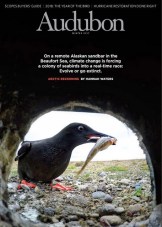
December cover of Audubon Magazine. Image Credit: Peter Mather for Audubon

The somewhat bad news is that the Audubon cover girl is not back.  While I have not been able to ascertain survival for all nests, it appears that the percentage of birds returning will be similar to last year: 20 to 25 percent.  The high mortality again has surviving birds pairing with neighbors since there are almost no nonbreeding birds to recruit.  Colony size will likely drop but, again, the amount is unknown now.

I’m still working out camp logistics and hoping the rest of the snow is gone soon so I can finish setting up camp.


This field report is part of an ongoing series titled Arctic Change centered around George Divoky’s 44th field season studying Black Guillemots, sea ice, and climate change on a remote Arctic island off the coast of Alaska. To donate and support Divoky’s work on Cooper Island, visit the Friends of Cooper Island.


Read more

Bird Banding by Alexandra Cleminson and Silke Nebel

Special delivery for the birds by George Divoky


Categories
Arctic Change

Making Camp in the Arctic

Cooper 2014
An aerial view of Cooper Island from 2014. Image Credit: George Divoky

Great to be back on Cooper island after two intense weeks of preparation in Seattle and Utqiaġvik. Arriving on the island begins an even more intense period as I need to turn the 8-by-12 foot cabin from the overwinter storage shed it has been for the past nine months into a place where I can sleep, cook, process data–and eventually even relax.

A low-level aerial shot of camp from just east, circa 2012. Image Credit: George Divoky

Concurrently, I have been setting up my power sources (solar and wind generators powering a battery bank) and communications (satellite phone, inReach and VHF radio) that keep the camp running and connected to the outside world. While the large snowdrift that currently surrounds my cabin impedes my accomplishing these tasks, it does provide my drinking water for the first half of the summer. Throughout the day I have been shoveling snow into any available container as the island has no fresh water and I need to melt as much snow as possible before it disappears.

All of the required logistics chores need to be balanced with the daily fieldwork. Since my arrival three days ago, conditions for censusing the colony and retrieving geolocators have been excellent with clear skies and little wind. While visiting all nest sites to determine who survived the winter and who is breeding with whom is the highest priority, I also need to retrieve the geolocators that I put on 25 birds at the end of the 2017 breeding season. Catching the birds in their nest cases has gone well this year with nine of the units retrieved in the past two days.

These light-sensitive data loggers record the time of sunrise and sunset each day allows me to determine their location for the nine months they have been away from the colony. We have deployed geolocators since 2011 and this year’s data is extremely important since the Bering Sea ice, where guillemots typically winter, did not form this past year. The effect of this unprecedented event on guillemot movements and distribution will be one of this summer’s most important findings.

guillemot2012
Black Guillemots in 2012. Image Credit: George Divoky

I will know the size of this year’s breeding population in about a week and, since many of the females have had low colony attendance in the last few days and are likely offshore building up reserves for egg laying, the first clutches should be appearing within the next 4-5 days.

Looking forward to sharing what is promising to be a most interesting and important field season.


This field is part of an ongoing series titled Arctic Change centered around George Divoky’s 44th field season studying Black Guillemots, sea ice, and climate change on a remote Arctic island off the coast of Alaska. To donate and support Divoky’s work on Cooper Island, visit the Friends of Cooper Island.


Read More

Arctic Sea Ice a Major Determinant in Mandt’s Black Guillemot Movement and Distribution During Non-Breeding Season by George Divoky, David Douglas, and Iain Stenhouse

He’s Watching the World Melt by John D. Sutter

SENtinels of the SEa Ice – SENSEI on ResearchGate

The Sensei Blog