Pierre-Loup Jan, Katie Morrison, George Divoky, and Maria Coryell-Martin in August of 2019 on Cooper Island. Image Credit: George Divoky
The positive signs of colony size and breeding effort
of the Black Guillemots on Cooper Island in June were too good to last.
After very high hatching success, the decreased ice
and increased water temperatures took their toll as parents were unable to find
prey in the warm, ice-free waters. Rapidly shifting ocean temperatures provided
some days of good growth, but currently only one third of chicks are still
alive. As the mortality was unfolding, we shared it with a reporter from the Washington
Post for an
article describing the impacts of climate change in Alaska in 2019.
The authors note that, “The early retreat of sea ice from the Bering and Chukchi seas has led to a jump in sea surface temperatures, altering weather patterns and upending the lives of residents who typically depend on the ice cover for hunting and fishing. It’s also affecting native species, including seals and seabirds.” In the article I describe the high rate of chick mortality from the loss of sea ice, which limits guillemots’ access to their preferred prey, Arctic cod.
Helping to monitor the changes that are rapidly occurring this summer are a Seattle science teacher, an expeditionary artist, and a French demographer. Pierre-Loup Jan, is a population dynamics modeler from the Centre d’étude biologique de Chizé, a local branch of the French National Centre for Scientific Research, analyzing the Cooper Island database as part of the Sentinels of Sea Ice (SENSEI) project lead by Christophe Barbraud and Yan Ropert-Coudert.
The SENSEI project aims at fighting against the reheating of the poles which have drastic consequences on the sea ice (decrease of the surface of the sea ice in Arctic and in contrario increase in Antarctica). Video Credit: BNP Paribas Foundation
On the island for the second time is Katie Morrison, board president for Friends of Cooper Island and an elementary school science educator in Seattle, WA. Maria Coryell-Martin, an expeditionary artist from Port Townsend, WA, is exploring the landscape and research of Cooper Island through watercolor sketches. Together, Katie and Maria are working on an interdisciplinary exhibit and educational materials.
Even in their short time on the island, they have
witnessed dramatic changes and the impact of a rapidly melting Arctic.
This
field report is part of an ongoing series titled Arctic Change centered around
George Divoky’s 45th field season studying Black Guillemots, sea ice, and
climate change on a remote Arctic island off the coast of Alaska. To donate and
support Divoky’s work on Cooper Island, visit the Friends
of Cooper Island website.
George Divoky at work in the Arctic. Image Credit: Mike Morrison
George and Thomas during 44th field season on Cooper Island. Imager Credit: Mike Morrison
George and Thomas tagging and releasing Black Guillemots. Image Credit: Mike Morrison
For the past four decades, my field seasons on Cooper Island studying Black Guillemots have always begun with high spirits and a feeling of optimism. Experiencing the 24 hours of daylight in early June while documenting the return of individual birds to the island and their nest sites is always uplifting – some of these seabirds have been returning to Cooper Island for decades. Then, the days begin to shorten as nighttime returns to the Arctic. After monitoring the colony’s breeding activity for over three months, the end of the field season in late August lacks the intensity of the start of the season, but until recently, provided the gratification of having a large number of nestlings depart the island – with the hope many will return in the coming years.
The end of my 2018 fieldwork was as atypical and unpredictable as the first part of the season. In June I saw the colony had experienced a major decline in breeding pairs due to unprecedented high overwinter mortality of adult birds and many of the birds that did return failed to either lay eggs or incubate the eggs they did lay.
After those initial indications that many of the adults were in poor condition in late June, I was surprised to find that the chicks had high survival in late July and August – unlike the widespread nestling mortality witnessed in 2017. Last year’s low breeding success, with the younger of the two nestlings dying in almost all nests, was due to an early and major retreat of the pack ice in the Beaufort Sea, making the guillemots’ preferred prey of Arctic Cod unavailable to foraging parents. This past summer’s sea ice retreat was later than last year and atypical in that, although much of the Beaufort was free of ice by late August, a large remnant of sea ice remained near the Alaskan coast keeping the waters near Cooper Island cold enough for Arctic Cod.
A large remnant of sea ice helped keep Arctic Cod in the Black Guillemot’s foraging range this summer. Image Credit: Alaska Ocean Observing System
Our last two weeks on the island were busy. In addition to monitoring the growth and departure of the guillemot fledglings, we spent many hours capturing adult birds and outfitting them with light-sensitive geolocation and activity data loggers. The high mortality during the nonbreeding season of 2017-2018 shows that winter conditions affecting adult survival, rather than the success of the breeding season, may now play the major role in determining the fate of the Cooper Island colony. As part of the SENSEI project, we deployed over 30 data loggers on adults that will provide us with information on their movements, distribution and activities from this fall until they return to the Cooper Island colony next spring.
My field assistants, Thomas Leicester and Mike Morrison, and I did see individual variation in the ability of the guillemot parents to find cod in the ice-free but cold (<4 degrees Celsius) foraging area. While some chicks weighed over 300 grams in their third week in the nest, some nests had young with large variation in daily growth and weights remaining in the low to mid 200 gram range. While it was heartening to see nearly 40 guillemot nestlings fledge this year, due to the number of nonbreeding pairs and those that abandoned eggs, chick production per active nest was well below the one fledging per nest needed to sustain a stable population.
Light-sensitive geolocation and activity data loggers help us learn where the Black Guillemots go during the winter. Image Credit: George Divoky
While I typically use my first week after the field season to slowly transition into an off-island existence, as I adjust to a life with running water, internet access and no polar bears, this year I traveled to Great Britain for the International Seabird Group Conference in Liverpool. I have always felt a kinship with British seabird researchers as my initial interest in conducting a long-term seabird study came from reading the books of Ronald Lockley, who in the early 20th Century decided to live on an uninhabited British island where he could study seabirds.
After the conference I traveled to the Centre d’Etudes Biologiques de Chizé where I am collaborating with Christophe Barbraud and others who, as part of the SENSEI project, are analyzing the 44 years of demographic data obtained on Cooper Island.
In spite of the highs and lows of the past three months, I am glad to have completed another field season of our long-term study. The unexpected findings of this past summer show that our work has never been more important as we continue to monitor a rapidly changing Arctic. I look forward to 2019 and hope things improve for the Black Guillemot colony in the 45th year of our fieldwork.
This is the last field report from Cooper Island for 2018; it is part of an ongoing series titled Arctic Change centered around George Divoky’s 44th field season studying Black Guillemots, sea ice, and climate change on a remote Arctic island off the coast of Alaska. To donate and support Divoky’s work on Cooper Island, visit the Friends of Cooper Island website.
Read more
Arctic Change, a Proteus Plumb Line Series featuring articles and field reports
Drew Sauve (standing) and Thomas Leicester set up a noose mat near a roost site in August, the rainiest month of the field season. Image Credit: Drew Sauve
Drew Sauve (standing) and Thomas Leicester set up a noose mat near a roost site in August, the rainiest month of the field season. Image Credit: Drew Sauve
The Black Guillemots on Cooper Island are one of many wild populations that are responding to climate change by changing when they lay their eggs. These Arctic seabirds want to lay their eggs as soon as the winter snow melts and spring begins, because their breeding season—from first access to a nest cavity to departure of chicks—is 80 days, an exceptionally long breeding period for a bird. Parent guillemots have to have their young ready to fly off to sea before fall snow accumulation begins to block entrances to nest cavities. In recent years, with sea ice retreating offshore in late summer, early breeding has the benefit of being able to provision young when the preferred prey of Arctic Cod is still readily available.
While there are decades of data that show spring snowmelt is occurring earlier in northern Alaska and, allowing guillemots to lay their eggs earlier, my research is focused on whether Black Guillemots are evolving to lay their eggs earlier.
George has created a detailed banding dataset, where every parent has a numbered metal band, and a unique colour band combination; all of their nestlings are banded before fledging. Using this data set, I can construct family trees for the birds breeding on the island. Family trees or pedigrees are often used in studies of human health or livestock breeding. In the rare case where we have long-term pedigrees in wild populations, geneticists can use them to determine genetic variation in a trait—in this case, when birds lay their eggs.
This visualization represents thee pedigree of Black Guillemots on Cooper Island. Blue lines link fathers to offspring and red lines like mothers to offspring. Each row is a generation of guillemots; each line lines a parent at the top and an offspring on the bottom. Individuals on the last row would belong to the 6thgeneration of guillemots on Cooper Island and have a great-great-great-great grandparent in the data set. Image credit: R package ‘pedantics’.
The amount of genetic variation or the potential for genetic change in a key trait like egg-laying date could determine whether a population will be able to adapt to climate change.
The analyses we do with a pedigree are similar to what a farmer might do when trying to select cows that produce more milk. Some cows and their families might produce more milk, so the farmer would select those cows when breeding their stock. Instead of cow families that produce lots of milk, I tried to find guillemot families that laid their eggs earlier than others in response to snowmelt. However, instead of a farmer selecting cows I wanted to see if climate change was selecting for earlier breeding guillemots.
Ultimately, there were no family groups that tended to lay earlier than others. Using my farmer example again, this would be like trying to select a cow with high milk output when all the families of cows produced the same amount of milk. The farmer would be unable to improve their herd because all the cows are the same with regards to milk production.
What this means on Cooper Island is that Black Guillemots are unlikely to evolve earlier laying dates to match warmer temperatures and the change in laying-date we’ve observed so far is not because of evolution. Rather individual birds are behaviorally adjusting their laying date due to changes in snowmelt.
Unfortunately, this behavioural response to snowmelt doesn’t seem to be enough of a response as the birds are still struggling to raise offspring in the warming Arctic.
The Cooper Island data demonstrate the power of long-term, detailed data collection. Just as George did not intend to study climate change when he started the study in 1975, I also do not think he intended on collecting data that one day would be useful for building a pedigree with multiple generations of Black Guillemots, but he did just that.
The value of long-term datasets might not always be apparent when starting the study, but much of our understanding of evolution, behavior, ecology, and responses to climate change come from research that span decades. I suspect that the Cooper Island dataset and others like it will continue to be valuable in the future.
Drew Sauve
Drew Sauve just finished his master’s with the Friesen Lab at Queen’s University, Canada and is starting a doctorate in September 2018 with Vicki Friesen and Anne Charmantier using the Cooper Island dataset to determine whether climate change is causing evolutionary change in chick growth. Drew is interested in evolution, ecology, genetics, and the responses of individuals and populations to environmental change.
This field report is part of an ongoing series titled Arctic Change centered around George Divoky’s 44th field season studying Black Guillemots, sea ice, and climate change on a remote Arctic island off the coast of Alaska. To donate and support Divoky’s work on Cooper Island, visit the Friends of Cooper Island website.
Cooper Island Black Guillemot in May 2017. Image Credit: George Divoky
Cooper Island Black Guillemot in May 2017. Image Credit: George Divoky
Nature, when observed or monitored for any extended period, typically provides a predictability that is reassuring in its consistency and sufficient surprises to keep one engaged.
For over four decades, my first task after I set up camp was a census of the Cooper Island Black Guillemot colony. This year was an excellent example of this balance of the expected and unexpected.
Colorful bands make it easy to identify familiar birds and newcomers (without bands). Image Credit: George Divoky
Since the 1970s, the majority of the birds breeding in the colony have had, in addition to a numbered metal band, a unique combination of color bands allowing identification with binoculars of individual birds. My census of the colony consists of recording the number of occupied nest sites and the color band combinations of the individuals occupying each site. This allows me to determine the birds who survived the winter since last year’s breeding season and whether they have retained the same nest site and mate.
Black Guillemots, like most seabirds, have high annual survival of adult birds and high mate and nest-site fidelity. On average 90 percent of the individuals breeding on Cooper have returned the following year with mate and nest-site fidelity over 95 percent. With loss of breeding birds so uncommon and changes in mate and nest site so rare, past censuses consisted primarily of confirming last year’s pair was again occupying a particular nest site. For the small number of nests where one member of a pair did not return, there typically was a new recruit already occupying the vacancy by the time of my census–either a bird banded as a nestling on Cooper Island or an immigrant, indicated by its lack of any bands.
In the past, the high survivorship of breeding birds meant that some of the individuals I resighted each June were ones I had seen for over 20 years, and in many cases had known since I had weighed them daily as a nestling. The resightings of these individuals as adults provided an annual touchstone that was an important part of both my emotional and scientific connection to the colony.
My initial census of the colony this year was unlike any in the past. The loss of breeding birds over the winter was the highest on record. Nearly one-third of the 170 birds that bred in 2017 not returning to the colony in 2018.
As mentioned in an earlier post, many of the 50 pairs that had eggs this year (down from 85 in 2017 and 100 in 2016) consisted of widowed birds that both lost a mate over the winter. The decrease in breeding population was exacerbated by the paucity of previously nonbreeding birds present to recruit into the breeding population. Some established breeders widowed over the winter are the sole occupants of their nest sites. Even pairs that did survive the winter have shown much lower mate and site fidelity than I have observed in previous years.
The disturbingly high percentage of birds lost to overwinter mortality comes as a major surprise but a simple percentage fails to capture the full impact of what I experienced during this year’s census.
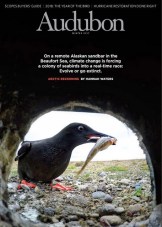
George’s “Cover Girl,” featured here on a December cover of Audubon Magazine, didn’t return to Cooper Island this year. Image Credit: Peter Mather for Audubon
Many of the individual birds I have known for decades were among those absent from the colony. Most notable was Yellow-Gray- Green, a 21-year-old female banded as a chick in 1996 and breeding on Cooper since 2001. She was featured on the cover of last winter’s Audubon magazine. Another individual absent this year with an even longer history on the island is White-Gray-Blue, who fledged from Cooper in 1989 and bred on the island during 23 years of rapid environmental change including of decreases in sea ice, warming ocean temperatures, increased polar bear nest predation and major shifts in prey availability.
While examining this year’s colony census at the level of the individual bird, versus a review of declining numbers is disheartening, it also provides some reasons for optimism–a rare feeling this field season.
My census found that a number of birds fledged from Cooper in recent years recruited into the breeding population this year, starting what I hope will be a long and productive career as breeders. These birds, and their young–the fledging chicks we hope they produce later this summer–provides one both with optimism and motivation to maintain the long-term study. As Hannah Waters pointed out in her excellent article in Audubon magazine, the guillemots are going to have to adapt and evolve for the colony to survive in a rapidly warming Arctic.
The hope that this year’s first-time breeders and their young will find a way to maintain the colony during the major changes occurring in the Arctic allows me to maintain a positive attitude as I continue to monitor this year’s breeding season.
This field report is part of an ongoing series titled Arctic Change centered around George Divoky’s 44th field season studying Black Guillemots, sea ice, and climate change on a remote Arctic island off the coast of Alaska. To donate and support Divoky’s work on Cooper Island, visit the Friends of Cooper Island website.
A lone Black Guillemot and sea ice off Cooper Island. Image Credit: George Divoky
A lone Black Guillemot and sea ice off Cooper Island. Image Credit: George Divoky
Black Guillemots and sea ice off Cooper Island. Image Credit: George Divoky
Mandt’s Black Guillemots. Image Credit: George DIvoky
George Divoky frets–with good reason. In 2016, CNN Correspondent John D. Sutter called him the man who is watching the world melt. The description is as distressing as it is apt.
George sends us regular dispatches from a small field camp on Cooper Island, about 25 miles east of Utqiaġvik, where he has studied a colony of nesting Mandt’s Black Guillemots for the last 44 years. Since his work began in 1975, the research has morphed into one of the longest-running studies of seabirds, sea ice, and climate change.
Guillemots look like small penguins headed off to a fancy party replete with ice sculptures and all-night dancing. Unlike other seabirds that migrate out of the region seasonally, they live out over the frigid waters year-round, only returning to land to breed and fledge their young–this makes them an excellent indicator of how climate change is impacting the Arctic.
Weather delayed the start of this research season in early June. While warm temperatures in the Arctic have made headlines in recent months, unusually late snow and ice kept the guillemots from reaching their nesting boxes until mid-June; the first egg was laid on June 24.
His communications are tinged with an effort to buoy spirits–I’m guessing his own more so than ours. This week, the bad news came first: a 29-year-old female died. He wrote that she had been banded during the first George Bush administration. (While many humans rely on a simple Gregorian calendar, George’s memories appear to be synchronized according to a timeline rooted firmly in geopolitics.)
Bad news was followed with happy; two siblings from the 2014 cohort returned and recruited partners for breeding.
Otherwise, it’s been a stormy week on the island. On July 20, he wrote that the wind was finally dying down. A bad week for the infrastructure, the camp’s weather station was blown over and part of the heavy-duty WeatherPort tarp separated from the frame, which caused a number of things to get wet. On Wednesday he saw record high rainfall for that date.
Egg laying hit an all-time low this year, with fewer breeding pairs than any previous year.
He’s asking questions about how changing ice conditions will impact these seabirds – his seabirds. In his most recent field report, he spoke at length about the relationship between the guillemots and nearshore sea ice. The location of the sea ice impacts how far parents will have to fly to access suitable prey for their chicks. Increased travel time means greater energy expended by parents – for seabirds that live predominantly out in open waters, it’s all about balancing resources and energy. The presence or absence of sea ice combined with the temperature of the ocean waters impacts the availability of Arctic Cod, the small nutritious fish the guillemots prefer.
George hopes the slowly departing nearshore sea ice will keep ideal prey in foraging range for the seabirds. He wrote, the cod is “urgently needed for the colony to reduce its current population decline.”
A MODIS image from July 11; snow and ice are cyan color while clouds tend to be more grayish. Image Credit: NASA Worldview
A MODIS image from July 16; snow and ice are cyan color while clouds tend to be more grayish. Image Credit: NASA Worldview
David Douglas is a research wildlife biologist for United States Geological Survey (USGS) Alaska Science Center; he and George are frequent collaborators. This week he emailed the MODIS images displayed above and wrote that Cooper Island was pretty well surrounded until July 16 when the persistent ice immediately around the island broke up and melted.
Studies like George’s will help scientists to better understand the ramifications of long-term warming and less sea ice for wildlife in the region. Impacts to wildlife will directly affect the lives of the people who depend on subsistence fishing and hunting for survival.
Warming Arctic conditions have persisted with 2018 reaching record lows for sea ice extent, according to a report published by NOAA and University of Alaska Fairbanks’s International Arctic Research Center.
Late ice formation and early retreat in the Chukchi and Bering Seas impacted local communities by making travel for subsistence hunting and fishing dangerous and, at times, impossible. Storm damage and erosion was worsened by exposed shorelines, left unprotected by a lack of sea ice. Island villages and coastal communities experienced flooding and property damage as well. You can read more about the storm impacts here and here.
The report attributes late and minimal ice coverage to warmer temperatures, particularly over the last four years. Increased temperatures combined with stronger storms helped break up weaker ice.
In 2018, there was less sea ice in the Bering Sea than any year since 1850, when commercial whalers began recording this data. Experts agree, loss of sea ice is a result of climate change. Continued warming creates a feedback loop where warming temperatures melt ice; without a reflective snow and ice covering, the ocean absorbs more of the sun’s warming rays and temperatures continue to rise.
Sea ice since 1850. Image Credit: NOAA and University of Alaska Fairbanks International Arctic Research Center (UAF-IARC).
As for future winters, what can people expect to see if warming continues at current rates?
“Communities need to prepare for more winters with low sea ice and stormy conditions. Although not every winter will be like this one,” concludes the report, “there will likely be similar winters in the future. Ice formation will likely remain low if warm water temperatures in the Bering Sea continue.”
And for George’s seabirds? How many birds will successfully fledge this year? How many will return next?
We’ll just have to wait and see.
This piece is part of an ongoing series titled Arctic Change centered around George Divoky’s 44th field season studying Black Guillemots, sea ice, and climate change on a remote Arctic island off the coast of Alaska. To donate and support Divoky’s work on Cooper Island, visit the Friends of Cooper Island website.
MODIS image from June 5; snow and ice have blue/cyan color, while clouds will be lighter gray/white. Image Credit: David Douglass/USGS
Over most of its range the Black Guillemot is a nearshore seabird, occupying coastal waters during both the breeding and nonbreeding seasons, as do other members of the genus Cepphus. Pelagic or open ocean waters can offer abundant prey resources, but these options are often distant, patchy and unpredictable.
The nearshore typically offers seabirds a smaller but more reliable source prey base consisting of forage fish and benthic fauna from the ocean floor such as crustaceans or mussels.
The Arctic Ocean has extensive sea ice cover in the nearshore for the majority of the year; this presents a number of challenges to a nearshore species. Our work on the Cooper Island Black Guillemots has revealed a number of ways in which the species has met these challenges.
The current view from my cabin window illustrates one of the major problems guillemots face in the Arctic. Sea ice extends from the north beach of the island to the horizon and covers Elson Lagoon to the south. The only water available to the guillemots is a brackish pond in the center of the colony that provides no prey but is deep enough to provide sanctuary if the guillemots need to dive when pursued by an owl or falcon — regular visitors to the island.
MODIS image from July 9; snow and ice have blue/cyan color, while clouds will be lighter gray/white. Image Credit: David Douglass/USGS
While guillemots arrived on the island almost a month ago and egg laying is now complete, until recently the closest predictable open water where guillemots could find prey was approximately 20 miles away, off Point Barrow where winds and currents shift the sea ice creating an area of open water. This opening is called a lead. The Cooper Island guillemots stage there in April and May before coming to the island. (Editor’s note: Leads are important for wildlife, because they allow for access to oxygen in the case of seals and walruses and prey in the case of seabirds; you can read more from the National Snow and Ice Data Center here.)
This distance between the Cooper Island guillemots’ nesting colony and access to their prey resources during egg laying and incubation is in sharp contrast to what guillemots breeding in subarctic or temperate waters find at their breeding colonies. These birds occupy waters directly adjacent to colonies well before egg laying and foraging areas may even be within sight of nests. The birds breeding on Cooper Island (and likely all colonies of Mandt’s Black Guillemot Cepphus grylle mandti, the high Arctic subspecies of Black Guillemot) have responded to this spatial disconnect by having a well-defined periodicity in their daily colony attendance. Every day, the parent not incubating eggs and all nonbreeding individuals vacate the colony from approximately noon until midnight. The birds fly individually or in small groups to open water where they can feed for almost half the day before returning to the colony just as the “midnight sun” is at its lowest point in the sky.
Cooper Island beach with nesting boxes from 2015. Image Credit: George Divoky
While it seems individual birds could fly offshore to open water to feed anytime during the day, there are a number of possible reasons the observed colony-wide pattern of attendance and abandonment developed. For the half of the day when the guillemots are absent – from approximately noon to midnight – there is no evidence that Cooper Island supports a colony of Black Guillemots. It appears to be just a barren sandbar that happens to inexplicably have 200 scattered black plastic cases along with a small cabin surrounded by a bear fence. Falcons, Snowy Owls, and other predators moving along the barrier islands would have little reason to be attracted to this place.
The timing of the birds’ departure and return may be related to changes in air temperature and its effect on ice formation. On nights when the air temperature is below freezing (as it was last night), I have frequently observed the formation of new ice on the surface of the few spaces of open water in the sea ice directly adjacent to shore. This newly formed ice melts in the morning as air temperatures rise. Nocturnal formation of new ice in the waters adjacent to the pack ice reduces the amount of open water available for guillemots to dive for the prey.
This temporary daily reduction in foraging area could be expected to have been pronounced during the Last Glacial Maximum when air temperatures were lower and the ancestors of the Cooper Island guillemots occupied an Arctic refugium. The current pattern of colony attendance for the Cooper Island colony – foraging during the warmest part of the day and attending the breeding colony at night – could have evolved as a way of maximizing the amount of open water available for guillemots.
The large expanse of shorefast ice north of the island this year is persisting later than expected compared to recent years. While the nearshore ice may now be forcing the Cooper Island guillemots to fly further in search of prey, it could benefit the colony later this summer should ice remain in the nearshore close to the colony. In recent years a lack of sea ice when the guillemots are feeding young resulted in increased nestling mortality as higher sea surface temperatures reduced the availability of Arctic Cod, the guillemots’ preferred prey.
Should this year’s nearshore ice break up slowly over the next month, Arctic Cod could remain in the guillemots’ foraging range and allow increased chick growth and fledging success. The latter is urgently needed for the colony to reduce its current population decline. First eggs will be hatching in about two weeks and our daily weighing of nestlings and prey observations should demonstrate how much this year’s persistent sea ice has affected the guillemots’ nearshore environment.
This field report is part of an ongoing series titled Arctic Change centered around George Divoky’s 44th field season studying Black Guillemots, sea ice, and climate change on a remote Arctic island off the coast of Alaska. To donate and support Divoky’s work on Cooper Island, visit the Friends of Cooper Island website.
George Divoky in the field at a Cooper Island nest site in 1972. Image Credit: George Divoky
George Divoky in the field at the first Black Guillemot nest site discovered on Cooper Island in 1972. Image Credit: George Divoky
The Cooper Island Black Guillemot study was recently mentioned in an Associated Press story by Seth Borenstein about researchers who “accidentally” began studying climate change. A number of scientists measuring a biological phenomenon have encountered unanticipated effects from climate change and understood those effects were more important, both biologically and politically, than what originally motivated them to initiate their research. The 44-year Cooper Island study has undergone a number of changes before its current focus on assessing the decadal effects of Arctic warming on seabirds.
When I first landed on Cooper Island in 1975, I had no intention of studying climate change or global warming.
Neither the globe nor the Arctic had warmed in the decades immediately preceding the start of my study. Research at the Cooper Island Black Guillemot colony started as part of a large federal program assessing Alaska’s then largely unknown marine ecosystems in anticipation of leasing offshore waters for oil development. Cooper Island was the furthest north of many seabird colonies in coastal Alaska where biologists documented the extent and basic biology of the state’s seabird resources in the late 1970s. When that program ended in 1981, due to a change of administrations and a less urgent need to move forward with offshore drilling, it had provided sufficient information for the drafting of environmental impact statements.
In 1982, lacking federal funding, and possibly more importantly logistical support, I made the decision to return to Cooper Island to continue the Black Guillemot study. I had developed a real attachment to northern Alaska with its field seasons of 24 hours of daylight and sea ice always visible just offshore. Through annual banding of breeding birds and their nestlings in the late 1970s, I had developed a population of largely known-history and known-age seabirds. I was initially drawn to the study of seabirds having read the works of British ornithologists conducting multi-year studies at a single colony and documenting the life histories of individual birds. Such work is beyond the scope and timeframe of pre-development environmental assessments and of federal agencies, with their frequently shifting agendas.
Only in the third decade of research was there an indication that increasing atmospheric temperatures were affecting the Black Guillemot colony. Earlier snowmelt in the 1990s allowed earlier initiation of breeding. Climate change impacts rapidly increased in the 21st Century as decreasing sea ice and increasing sea surface temperatures reduced the guillemots’ preferred prey and greatly reduced breeding success. The least nuanced sign of Arctic warming, polar bears stranded on the island approaching our field camp, began in 2002 and this will certainly occur again this summer.
While monitoring the effects of climate change will continue to be the focus of the work, the study is now proceeding in ways never anticipated in 1975. Since 2011, we have deployed biologgers on the bands of guillemots to measure diving behavior during breeding and location and activity of birds during the nonbreeding season. That work is being continued and analyzed as part of the Sentinels of Sea Ice (SENSEI) project, which this fall will have our collaborators from France’s National Center for Scientific Research (CNRS) hiring a post-doc to examine our demographic database.
Vicki Friesen of Queen’s University in Kingston, Ontario has a graduate student, Drew Sauve, examining the genetics of individual guillemots and the heritability of the metrics we have obtained on breeding biology. Drew recently completed a master’s degree on the heritability of timing of egg laying and is beginning a doctoral program utilizing the Cooper Island colony and database. He will be joining me on the island later this month to gather additional genetic material.
As I walked around the colony this past week in this 44th year of the study, determining nest ownership and dates of egg laying, it is extremely satisfying to know the data is part of a data set spanning six generations of guillemots and can provide unparalleled insights into the biology of an Arctic seabird experiencing a rapidly changing environment.
This field report is part of an ongoing series titled Arctic Change centered around George Divoky’s 44th field season studying Black Guillemots, sea ice, and climate change on a remote Arctic island off the coast of Alaska. To donate and support Divoky’s work on Cooper Island, visit the Friends of Cooper Island.
NOAA Ship Bell M. Shimada is a state-of-the-art fisheries survey vessel that studies a wide range of marine life, sea birds and ocean conditions along the U.S. West Coast. Image Credit: NOAA
NOAA Ship Bell M. Shimada is a state-of-the-art fisheries survey vessel that studies a wide range of marine life, sea birds and ocean conditions along the U.S. West Coast. Image Credit: NOAA
I’m preparing to mobilize with a team of scientists on board the NOAA Ship Bell M. Shimada on July 2. We’ll spend the next nine days cruising from San Francisco through three National Marine Sanctuaries — Cordell Bank, Greater Farallones, and Monterey Bay — collecting water samples and looking for seabirds and marine mammals.
National Marine Sanctuaries along the California Coast. Image Credit: Cordell Bank National Marine Sanctuary
The expedition is part of a 15-year project called Applied California Current Ecosystem Studies (ACCESS), which aims to study linkages between weather, oceanographic conditions, and climate change within the sanctuary system. One of the main things they will observe and monitor is prey distribution in order to help identify areas where seabirds and whales might be heading for their next meal.
By locating places where foraging might overlap with human activity, sanctuary managers can help reduce the risk of harm to wildlife — ship strikes and entanglement in fishing gear is a major problem scientists are working to address.
Each year, three to five ACCESS cruises are conducted; over time, the data collected on these expeditions may reveal trends, which might help shed light on how climate change impacts the ocean, and subsequently all of us. Extreme warm water events are a particularly important area for study, because the temperature fluctuations disrupt the food web and can lead to major die-offs.
ACCESS is a partnership between NOAA National Marine Sanctuaries and Point Blue, a nonprofit conservation science organization founded in 1965. Collaborations with at least 10 public and private organizations also aids in processing and analyzing samples and data collected during expeditions.
For a series we’ve titled Sea Sentries, I’ll be posting regular updates with photos, interviews, and stories to help deliver our readers out into our National Marine Sanctuaries, so check back regularly and join me at sea!
Jenny Woodman, Proteus founder and executive director, is a science writer and educator living in the Pacific Northwest. She has spent the last four years writing about ocean health, technology and she is a 2018 lead science communication fellow for the Exploration Vessel (E/V) Nautilus. Her work can be found in Atlantic Monthly, IEEE Earthzine, and Ensia Magazine.
Eggs in a Nanuk case (nest J-09) from a previous season. Image credit: George Divoky
FIRST EGG!!!
The first egg of the 2018 breeding season was laid today (June 24th) by White-Black-Gray (for more on bird banding, see link below). She fledged from Cooper Island in 1995 and has lived through a period of major climate change in the Arctic.
For the last decade, she has always been one of the first females to lay. Hoping she, and the other 150 guillemots in the colony, have a successful breeding season.
December cover of Audubon Magazine. Image Credit: Peter Mather for Audubon
The somewhat bad news is that the Audubon cover girl is not back. While I have not been able to ascertain survival for all nests, it appears that the percentage of birds returning will be similar to last year: 20 to 25 percent. The high mortality again has surviving birds pairing with neighbors since there are almost no nonbreeding birds to recruit. Colony size will likely drop but, again, the amount is unknown now.
I’m still working out camp logistics and hoping the rest of the snow is gone soon so I can finish setting up camp.
This field report is part of an ongoing series titled Arctic Change centered around George Divoky’s 44th field season studying Black Guillemots, sea ice, and climate change on a remote Arctic island off the coast of Alaska. To donate and support Divoky’s work on Cooper Island, visit the Friends of Cooper Island.
Read more
Bird Banding by Alexandra Cleminson and Silke Nebel


You must be logged in to post a comment.