Categories
Exploring Ocean Worlds Sea Sentries

Being On Station

Chase-CTD
The deck crew works to return the CTD rosette to the side deck. Image Credit: Julie Chase/ACCESS/NOAA/Point Blue

We’re on the fourth day of an Applied California Current Ecosystem Studies, or ACCESS, cruise — a long-term effort, now in its 15th year, to monitor and understand the oceanographic conditions, prey availability, and abundance and distribution of seabirds and whales in the region. The data collected on these cruises, which take place three to five times per year, are used to help inform decision-making and research priorities in North-Central California National Marine Sanctuaries. ACCESS is a partnership between NOAA National Marine Sanctuaries and Point Blue Conservation Science.

On the flying bridge, the observers and data logger are bundled for what is shaping up to be the coldest and windiest day of the expedition so far. The radios many of us wear, click and buzz in unison, “Bridge to flying bridge, 15 minutes to the end of the line.”

“Copy that, thank you,” Data Logger Taylor Nairn replies.

Yesterday, the ocean merged into the sky at the horizon point with rich shades of blue, but today grey blends into grey. The quiet is peaceful.

Once we reach the end of this transect line, we will be “on station.” At set points along each transect line, there are five to six stations where the ship stops so a team can collect samples using a variety of equipment and techniques. As the wildlife observers’ work for the morning concludes, the wet lab team and deck crew spring into action.

Jamie Jahncke is the director of the California Current Group for Point Blue Conservation Science. He selected these points along the transect for sample collection. To Jahncke, the greater number of sampling locations allow his team to paint a more accurate portrait of what is happening where the warm, surface layer of water rests on top of the cold nutrient-rich layer.

He explains, when people look at water, everyone thinks it all looks the same, but it’s not. There are all these points where tiny differences in temperature will impact the distribution of food and prey. “We’re looking for places where critters tend to aggregate, attracting seabirds and whales,” says Jahncke.

Down on the side deck, the Conductivity, Temperature, Depth (CTD) rosette is deployed. The CTD carries 12 Niskin bottles with levers that allow the team to open them strategically, collecting water samples at various depths up to 500 meters. (A detailed explanation of this can be found here and here.)

According to Jahncke, measuring how well a water sample conducts electricity, also known as conductivity, is directly related to salinity. Salinity is the concentration of salt and other inorganic compounds in seawater. Salty seawater is heavier than freshwater, as is cold water. Combined with temperature data, scientists are able to better understand how water properties and nutrients are distributed throughout the water column.

While crew and wet lab team are out on the side deck, Grace Kumaishi is inside prepping labels and materials for the samples that will come in. There’s a great deal of labeling and packaging to do, so it is clear when and where the materials were gathered. Additionally, the findings will be shared with least 10 different federal, state, and non-government research institutions.

Kumaishi was really nervous for this, her first big cruise. She’s a research assistant at Point Blue. Having just completed her bachelor’s in ecology, behavior, and evolution at University of California Los Angeles, she’s in that nebulous period between undergraduate work and grad school. She’s debating the pros and cons of masters and Ph.D. programs. This internship with Point Blue offers her the opportunity to build relationships with mentors, watch graduate students conduct their research, and see firsthand what a career in ocean science might look like.

Most days for Kumaishi are spent in the lab processing samples collected on cruises such as this one. “It’s really nice to get out of the lab and do some field work,” she says.

Chase-carinactd
Carina Fish collects water samples for her research on the ways climate change is altering ocean chemistry. Image Credit: Julie Chase/ACCESS/NOAA/Point Blue

Outside, the CTD is back on the deck and Carina Fish collects her samples first. Fish is doctoral candidate in marine biogeochemistry at University of California Davis’s Bodega Marine Laboratory. Using a small tube from the bottom of the bottle on the rosette, she rinses out a small brown glass bottle with seawater to make sure there are no contaminants. Then, she gives it a good shake, dumps the contents, and collects her sample. When Fish finishes she calls out, “Ryan, you ready?” He is there in a flash, using same process as Fish.

Ryan Anderson is working on a master’s in marine science with an emphasis on physical and chemical oceanography at San Francisco State University. The samples he gathers will be sent to a San Francisco State University lab to determine the amount of nutrients in the water.

Once Fish fills all her bottles, she adds mercuric chloride to each one; the chemical halts growth of any biological materials in the water without interacting with the carbonate chemistry that interests her.

Yesterday, Fish and I were up on the bow looking at a massive bloom of Chrysaora, or sea nettles. I asked her about the jellies; laughing loudly, she joked that she doesn’t know anything about “the living stuff.” Fish studies aragonite saturation states, which are used to track ocean acidification, a condition caused by climate change.

There’s a constant hum from the winch overhead and the deck vibrates beneath our feet. Everyone is wearing brightly colored foul weather gear, life jackets, and hard hats. On the side deck, we’re only about 12 feet above the water with heavy machinery and the ever-present threat of rough seas — safety is key.

Chase-GraceMeredith
Grace Kumaishi and Meredith Elliott retrieve zooplankton collected in a hoop net from the side deck of the NOAA Ship Bell M. Shimada. Image Credit: Julie Chase/ACCESS/NOAA/Point Blue

After the CTD is pulled in, the hoop net is carefully lowered over the side. Ship speed and the amount of cable released impact the success of this process, so there’s a great deal of coordination between the bridge, the winch operator, the deck crew, and the wet lab team. If the cable is not at the correct angle, the net will drag at a depth that doesn’t pull in the zooplankton.

Once retrieved, Point Blue Senior Scientist and Program Biologist for ACCESS Meredith Elliott and Kumaishi rinse the hoop net to direct everything captured down into a container at the bottom of the net called a cod end. The contents are dumped into a sieve and filtered. Elliott carefully rinses everything several times to make sure she gets all the biological samples.

The nets are used to measure the quantity and variety of food sources available for the wildlife being observed and counted on the flying bridge. This process will be repeated at each station on the transects completed every day.

People mill; everyone has to wait for the moment when it’s time to perform their individual part in the production. Since timing is of the essence, no one leaves until the deck ops are complete, in spite of the aroma of pulled pork and warm spices wafting from mess.

It is time for lunch, but not until the work is done.


Jenny Woodman, Proteus founder and executive director, is a science writer and educator living in the Pacific Northwest. Follower her on Twitter @JennyWoodman.


Read more

Climate Change and Ocean Acidification by Cordell Bank National Marine Sanctuary

Searching for Answers at Sea: 2016 West Coast Ocean Acidification Cruise by Jenny Woodman


Categories
Exploring Ocean Worlds Sea Sentries

The Uncommon Common Murre


Common Murre are abundant here; many can be seen carrying fish on a return flight to the Farallon Islands, where hungry babies eagerly wait for their next meal. The islands — uninhabited by humans except for a small group of scientists — are nesting grounds for thirteen species of seabirds and six species of marine mammals that breed or haul out on the islands each year.

According to U.S. Fish & Wildlife service, the Farallons host the largest seabird nesting colony south of Alaska with numbers greater than 350,000 in the summer, including nesting Common Murres, Tufted Puffins, Pigeon Guillemots, and Western Gulls.

Just 27 miles west of San Francisco, these rocky islands weren’t always an ideal habitat for seabirds. During the California Gold Rush, a lack of agricultural infrastructure led hungry prospectors and entrepreneurial foragers to the Farallons for eggs, which pushed the Common Murre to the brink of extinction.

Over the years, a combination of exploitation from hunting and foraging to military uses left the island in a state of disarray. Feral cats and nonnative rabbits introduced by previous inhabitants obliterated many seabirds. Oil spills and pollution also took a toll on the habitat, which was established as a national wildlife refuge in 1909 by Theodore Roosevelt. Since the late 1960s, partnerships between U.S. Fish & Wildlife, NOAA, and Point Blue Conservation Science have helped to restore and maintain the Farallons for wildlife and research.

fig1
Computer imagery shows the topography of the seafloor of Greater Farallones National Marine Sanctuary and the steep drop-off of the continental slope west of the Farallon Islands. Image Credit: USGS/Woods Hole

We’re here on the second day of an Applied California Current Ecosystem Studies, or ACCESS, cruise. It is part of a long-term effort, now in its 15th year, to monitor and understand the oceanographic conditions, prey availability, and abundance and distribution of seabirds and whales in the region.

The data collected on these cruises, which take place three to five times per year, are used to help inform decision-making and research priorities in Northern and Central California National Marine Sanctuaries. ACCESS is a partnership between NOAA National Marine Sanctuaries and Point Blue Conservation Science.

Seabirds and marine mammals are drawn to the region by a process called upwelling. In the spring, strong winds move across the surface of the ocean circulating and drawing cold, nutrient-rich water from the deep ocean areas that lie below the edge of the Continental Shelf and Slope. This process is part of what makes these waters, according to NASA, “some of the most biologically productive in the world.”

When these nutrients reach the sunlight at the surface, the perfect environment is created for marine plant life — from phytoplankton to kelp forests. The plants, in turn, feed the wildlife.

Krill thrive in these nutrient-rich waters. “Its size is tiny, but its significance is colossal,” Mary Jane Schramm writes. “Krill – a shrimp-like crustacean – forms the basis of the marine food web for whales, seabirds, fish, squid, seals, and sharks throughout the world’s oceans.”

As we zigzag along the coast via predetermined transect lines, this productivity is evident in both the variety and quantity of life seen here.

The expert wildlife observers are armed with details to make each sighting even more exciting. When prompted, Dru Devlin, research associate for Greater Farallones Association, offers up a litany of fascinating details about the Common Murres, which nest on steep, rocky cliffs.

P1120994-e1495499040662-1024x692
Common Murres on Farallon Islands. Image Credit: Point Blue Conservation Science

The female lays one large blue egg, which she sits on for the duration without nourishment. When the egg finally hatches, she takes off to replenish her strength for whatever lies ahead and the father steps in to take care of the baby chick. (In Far from Land: The Mysterious Life of Seabirds, Michael Brooke points out that seabirds generally only produce one to two eggs per year, which he adds is smart evolutionary strategy, because otherwise the ocean would be full of birds with nothing to eat!)

Murre chicks leave the nest, before they’ve fledged, meaning they haven’t grown flight feathers. When the time comes, the father and chick leap off the steep cliff and into the water below where the little one floats for up to two months, waiting for its flight feathers to come in.

Yesterday, we heard a cacophony of bird calls throughout the day; Devlin explained that we were hearing the father birds calling out to their chicks as they returned from fishing for food. Devlin concludes her explanation by asking me to imagine what it must be like to look for your baby in the midst of rough seas and large swells and I find myself, once again, awestruck by the tenacity of seabirds.


In a very short period of time, I’ve seen so much. As a city kid from Philadelphia, my encounters with animals outside of zoos were limited to squirrels and pigeons, so much of these sightings are pretty big firsts for me. While everyone was busy deploying equipment on a side deck after breakfast, I ducked around a corner for a quiet moment and found myself alone with a pod of Pacific white-sided dolphins, playfully lingering alongside our vessel.

Observing these creatures is a rare treat made even better when accompanied by a team of biologists and wildlife experts to explain what I see and fill me with a sense of wonder for new favorites like the uncommon Common Murres.

Spotted Wednesday, July 4:

Common Murres

Sooty Shearwaters

Sabine’s Gulls

Herring Gulls

Brown Pelicans

Cassin’s Auklets

Blue Whales

Humpback Whales

Unidentified Whales

California Sea Lions


Jenny Woodman, Proteus founder and executive director, is a science writer and educator living in the Pacific Northwest. Follower her on Twitter @JennyWoodman.


This article was updated on July 5.

Read more

History of Farallon Islands by U.S. Fish & Wildlife Service

Farallon National Wildlife Refuge by U.S. Fish & Wildlife Service

California Coastal Current by NASA Earth Observatory

The Farallon Islands are Off Limits to Humans – but Not Wildlife by Bonnie Tsui

Common Murre Identification by Cornell Lab of Ornithology

Tiny Krill: Giants in the Marine Food Chain by Mary Jane Schramm for NOAA National Marine Sanctuaries

Categories
Exploring Ocean Worlds Sea Sentries

Finding My Sea Legs and an Awkward Encounter with a Gumby Suit

OLYMPUS DIGITAL CAMERA
Pelicans flying near Gate Bridge in San Francisco. Image Credit: Jenny Woodman/ACCESS/NOAA/Point Blue

We sailed under the Golden Gate Bridge in San Francisco just before 11 a.m. on July 3. Anyone without immediate tasks to perform worked on finding their sea legs while we transited to our first location.

For me, this included several hours becoming one with my berth as this was the only place where I didn’t feel as if my stomach was planning on making our cabin’s head a permanent home. The bunks are incredibly comfortable with curtains for privacy and a mattress that envelops – something I genuinely appreciated when the ship really started rolling. We are zigzagging along predetermined paths from east to west, and then west to east. When traveling west, the going can get pretty rough because we’re moving against the swells.

I heard the waves slapping the side of the ship with a ferocity that made the vessel seem much smaller than she is. The seas were actually quite calm, but there were still moments when it felt as if we were perched on a cork, bobbing in a boiling caldron of water.

img_7702
Jenny Woodman in a “Gumby” suit after an abandon ship drill. Image Credit: Jenny Woodman/ACCESS/NOAA/Point Blue

My queasy, but cozy respite was interrupted by an abandon ship drill before lunch. This required mustering in predetermined locations with our life vests and immersion survival suits. Each of us donned our own unwieldy orange neoprene “Gumby suit,” which is designed to keep the wearer floating and dry in cold water while awaiting rescue. The NOAA officer in charge of my assigned life boat, Lieutenant Jesse Milton, was kind and didn’t laugh at my ineptitude. Nonetheless, after attempting to stand and zip the suit on the back deck of the ship, I suspect I wouldn’t fare too well if anything were to actually go wrong.

The expedition is part of a project, now in its 15th year, to better understand and monitor the marine ecosystems off the coast of Northern and Central California. The Applied California Current Ecosystem Studies (ACCESS) cruises happen three to five times each year.

Screen Shot 2018-07-03 at 6.13.55 PM
The transect lines on the map show the locations visited multiple times each year by scientists studying how oceanography and prey distribution impacts wildlife in the region. Image Credit: ACCESS/NOAA/Point Blue

Each cruise returns to specific locations and travels along what are called transect lines; there are a total of 21 lines in the area being studied, which stretches from Northern to Central California. Jaime Jahncke is the California Current Director for Point Blue Conservation Science, the organization collaborating with NOAA to conduct the ACCESS work. He explains that repeat visits to the same locations help scientists assess change over time, from season to season and year to year.

With the data collected on these cruises, the team is able to compare warm years like 2014-2015 to previous warm periods and see that there were fewer krill, the preferred food source for many of the wildlife feeding here, and more gelatinous zooplankton, which are less nutritious. When appropriate food sources are less abundant, observers see wildlife feeding closer to shore and subsequently, closer to shipping lanes, which increases the chances of ship strikes and entanglement.

We completed our first transect by mid-afternoon. While traveling along these lines, a group of scientists stay on the upper deck of the ship, which is called the flying bridge. Each person has a specific job.

chase-180703-6835-2
Wildlife observers on the flying bridge from right to left: Taylor Narin, Dru Devlin, and Kirsten Lindquist. Image Credit: Julie Chase/ACCESS/NOAA/Point Blue

Kirsten Lindquist is the birder on this cruise and the ecosystem monitoring manager for the Greater Farallones Association (GFA). (You can read more about GFA’s efforts to support NOAA and the Sanctuaries here.)

Lindquist says, “Common murre, six, at three-two-zero, flying, zone two, with fish.” Then, Taylor Nairn, the data manager for GFA, logs the observations in a laptop.

Then, the Research Coordinator for Greater Farallones National Marine Sanctuary and Chief Scientist for this cruise Jan Roletto calls out mammal sightings, “Blow . . . unknown whale, traveling.” She is working alongside Dru Devlin, a wildlife observer with a long history conducting surveys for ACCESS and GFA’s citizen science program, Beach Watch.

The highlight for me was seeing my first Tufted Puffin, which was beautiful.

chase-180703-7223
Mola mola in Greater Farallones National Marine Sanctuary. Image Credit: Julie Chase/ACCESS/NOAA/Point Blue

Spotted on July 3:

Common Murres
Western Gulls
Red-necked Phalaropes
Sooty Shearwaters
Pink-Footed Shearwaters
Black-Footed Albatross
Northern Fulmar
Rhinoceros Auklets
Cassin’s Auklets
South Polar Skua
Tufted puffin
California Sea Lions
Fin Whales
Blue Whales
Humpback Whales
Unidentified Whales
Mola molas


Jenny Woodman, Proteus founder and executive director, is a science writer and educator living in the Pacific Northwest. She writes about ocean health, technology, and climate change; she is a 2018 lead science communication fellow for the Exploration Vessel (E/V) Nautilus. Her work can be found in Atlantic Monthly, IEEE Earthzine, and Ensia Magazine.


Read more

Pocket Guide to Beach Birds of California by Point Blue Conservation Science

52 Years of Conservation…and Still Counting by Point Blue Conservation Science

Applied California Current Ecosystem Studies (ACCESS)  by Greater Farallones National Marine Sanctuary


Categories
Arctic Change

Work Worth Doing

G. Divoky at BG-1 1972
George Divoky in the field at the first Black Guillemot nest site discovered on Cooper Island in 1972. Image Credit: George Divoky

The Cooper Island Black Guillemot study was recently mentioned in an Associated Press story by Seth Borenstein about researchers who “accidentally” began studying climate change. A number of scientists measuring a biological phenomenon have encountered unanticipated effects from climate change and understood those effects were more important, both biologically and politically, than what originally motivated them to initiate their research. The 44-year Cooper Island study has undergone a number of changes before its current focus on assessing the decadal effects of Arctic warming on seabirds.

When I first landed on Cooper Island in 1975, I had no intention of studying climate change or global warming.

Neither the globe nor the Arctic had warmed in the decades immediately preceding the start of my study. Research at the Cooper Island Black Guillemot colony started as part of a large federal program assessing Alaska’s then largely unknown marine ecosystems in anticipation of leasing offshore waters for oil development. Cooper Island was the furthest north of many seabird colonies in coastal Alaska where biologists documented the extent and basic biology of the state’s seabird resources in the late 1970s. When that program ended in 1981, due to a change of administrations and a less urgent need to move forward with offshore drilling, it had provided sufficient information for the drafting of environmental impact statements.

In 1982, lacking federal funding, and possibly more importantly logistical support, I made the decision to return to Cooper Island to continue the Black Guillemot study. I had developed a real attachment to northern Alaska with its field seasons of 24 hours of daylight and sea ice always visible just offshore. Through annual banding of breeding birds and their nestlings in the late 1970s, I had developed a population of largely known-history and known-age seabirds. I was initially drawn to the study of seabirds having read the works of British ornithologists conducting multi-year studies at a single colony and documenting the life histories of individual birds. Such work is beyond the scope and timeframe of pre-development environmental assessments and of federal agencies, with their frequently shifting agendas.

Only in the third decade of research was there an indication that increasing atmospheric temperatures were affecting the Black Guillemot colony. Earlier snowmelt in the 1990s allowed earlier initiation of breeding. Climate change impacts rapidly increased in the 21st Century as decreasing sea ice and increasing sea surface temperatures reduced the guillemots’ preferred prey and greatly reduced breeding success. The least nuanced sign of Arctic warming, polar bears stranded on the island approaching our field camp, began in 2002 and this will certainly occur again this summer.

While monitoring the effects of climate change will continue to be the focus of the work, the study is now proceeding in ways never anticipated in 1975. Since 2011, we have deployed biologgers on the bands of guillemots to measure diving behavior during breeding and location and activity of birds during the nonbreeding season. That work is being continued and analyzed as part of the Sentinels of Sea Ice (SENSEI) project, which this fall will have our collaborators from France’s National Center for Scientific Research (CNRS) hiring a post-doc to examine our demographic database.

Vicki Friesen of Queen’s University in Kingston, Ontario has a graduate student, Drew Sauve, examining the genetics of individual guillemots and the heritability of the metrics we have obtained on breeding biology.  Drew recently completed a master’s degree on the heritability of timing of egg laying and is beginning a doctoral program utilizing the Cooper Island colony and database. He will be joining me on the island later this month to gather additional genetic material.

As I walked around the colony this past week in this 44th year of the study, determining nest ownership and dates of egg laying, it is extremely satisfying to know the data is part of a data set spanning six generations of guillemots and can provide unparalleled insights into the biology of an Arctic seabird experiencing a rapidly changing environment.


This field report is part of an ongoing series titled Arctic Change centered around George Divoky’s 44th field season studying Black Guillemots, sea ice, and climate change on a remote Arctic island off the coast of Alaska. To donate and support Divoky’s work on Cooper Island, visit the Friends of Cooper Island.


Read more

Alaska’s North Slope Snow-Free Season is Lengthening from University of Colorado Boulder

Exit, Pursued by Bear by George Divoky

Categories
Exploring Ocean Worlds Sea Sentries

Science at Sea

NOAA-Ship-Bell-M.-Shimada-underway_Photo-courtesy-NOAA
NOAA Ship Bell M. Shimada is a state-of-the-art fisheries survey vessel that studies a wide range of marine life, sea birds and ocean conditions along the U.S. West Coast. Image Credit: NOAA

I’m preparing to mobilize with a team of scientists on board the NOAA Ship Bell M. Shimada on July 2. We’ll spend the next nine days cruising from San Francisco through three National Marine Sanctuaries — Cordell Bank, Greater Farallones, and Monterey Bay — collecting water samples and looking for seabirds and marine mammals.

cbnms-updated-map
National Marine Sanctuaries along the California Coast. Image Credit: Cordell Bank National Marine Sanctuary

The expedition is part of a 15-year project called Applied California Current Ecosystem Studies (ACCESS), which aims to study linkages between weather, oceanographic conditions, and climate change within the sanctuary system. One of the main things they will observe and monitor is prey distribution in order to help identify areas where seabirds and whales might be heading for their next meal.

By locating places where foraging might overlap with human activity, sanctuary managers can help reduce the risk of harm to wildlife — ship strikes and entanglement in fishing gear is a major problem scientists are working to address.

Each year, three to five ACCESS cruises are conducted; over time, the data collected on these expeditions may reveal trends, which might help shed light on how climate change impacts the ocean, and subsequently all of us. Extreme warm water events are a particularly important area for study, because the temperature fluctuations disrupt the food web and can lead to major die-offs.

ACCESS is a partnership between NOAA National Marine Sanctuaries and Point Blue, a nonprofit conservation science organization founded in 1965. Collaborations with at least 10 public and private organizations also aids in processing and analyzing samples and data collected during expeditions.

For a series we’ve titled Sea Sentries, I’ll be posting regular updates with photos, interviews, and stories to help deliver our readers out into our National Marine Sanctuaries, so check back regularly and join me at sea!


Jenny Woodman, Proteus founder and executive director, is a science writer and educator living in the Pacific Northwest. She has spent the last four years writing about ocean health, technology and she is a 2018 lead science communication fellow for the Exploration Vessel (E/V) Nautilus. Her work can be found in Atlantic Monthly, IEEE Earthzine, and Ensia Magazine.


Read more

Why protect 600,000 square miles that most people will never see? by Jenny Woodman

National Marine Sanctuaries

History of National Marine Sanctuaries

Categories
Arctic Change

Seabird Update

nanuk case pair
A pair of nesting guillemots from 2011. Image Credit: George Divoky

30 nests with eggs–about half of the active nests! In recent years, few eggs have been laid in July, but not this year.

Adult survival is apparently as low as last year (about 75 percent compared to the long-term average of 90 percent). Unlike last year, there are a number of 3-yr-olds that fledged in 2015 and have reached the age when guillemots first breed.

Screen Shot 2018-06-29 at 10.00.38 AM
Nonbreeding Peregrine Falcons occasionally stop by Cooper Island and are interested in both Black Guillemot adults and nestlings. This one was caught on a motion-sensitive camera as it hoped a chick might appear at the entrance. Image Credit: Goerge Divoky

While last year’s many widowed birds paired with their widowed neighbors (resulting in the decrease in nest sites) this year new birds are occupying the vacancies resulting from the increased mortality.

Guillemots typically don’t breed until their third year. There are even a few pairs this year with both members consisting of returning Cooper birds breeding for the first time.

Just finished the adult census as a Peregrine kept birds offshore or in sites for 2 days.

Getting the WeatherPort (which is basically a heavy-duty canvas structure, similar to a yurt) set up now — more later.


This field report is part of an ongoing series titled Arctic Change centered around George Divoky’s 44th field season studying Black Guillemots, sea ice, and climate change on a remote Arctic island off the coast of Alaska. To donate and support Divoky’s work on Cooper Island, visit the Friends of Cooper Island.


Read More

Black Guillemots Life History by Cornell Lab of Ornithology

Categories
Arctic Change

The First Egg!

P1000368-620x465
Eggs in a Nanuk case (nest J-09) from a previous season. Image credit: George Divoky

FIRST EGG!!!

The first egg of the 2018 breeding season was laid today (June 24th) by White-Black-Gray (for more on bird banding, see link below). She fledged from Cooper Island in 1995 and has lived through a period of major climate change in the Arctic.

For the last decade, she has always been one of the first females to lay. Hoping she, and the other 150 guillemots in the colony, have a successful breeding season.

Screen Shot 2018-05-18 at 1.36.12 PM
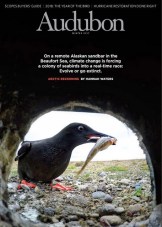
December cover of Audubon Magazine. Image Credit: Peter Mather for Audubon

The somewhat bad news is that the Audubon cover girl is not back.  While I have not been able to ascertain survival for all nests, it appears that the percentage of birds returning will be similar to last year: 20 to 25 percent.  The high mortality again has surviving birds pairing with neighbors since there are almost no nonbreeding birds to recruit.  Colony size will likely drop but, again, the amount is unknown now.

I’m still working out camp logistics and hoping the rest of the snow is gone soon so I can finish setting up camp.


This field report is part of an ongoing series titled Arctic Change centered around George Divoky’s 44th field season studying Black Guillemots, sea ice, and climate change on a remote Arctic island off the coast of Alaska. To donate and support Divoky’s work on Cooper Island, visit the Friends of Cooper Island.


Read more

Bird Banding by Alexandra Cleminson and Silke Nebel

Special delivery for the birds by George Divoky


Categories
Arctic Change

Flying to Cooper

This short one-minute video shows the approach to Cooper Island from a North Slope Search and Rescue Helicopter loaded with 800 pounds of gear and our intrepid field scientist, George Divoky. Video Credit: Leslie Pierce


This clip is part of an ongoing series titled Arctic Change centered around George Divoky’s 44th field season studying Black Guillemots, sea ice, and climate change on a remote Arctic island off the coast of Alaska. To donate and support Divoky’s work on Cooper Island, visit the Friends of Cooper Island.


Categories
Arctic Change

Making Camp in the Arctic

Cooper 2014
An aerial view of Cooper Island from 2014. Image Credit: George Divoky

Great to be back on Cooper island after two intense weeks of preparation in Seattle and Utqiaġvik. Arriving on the island begins an even more intense period as I need to turn the 8-by-12 foot cabin from the overwinter storage shed it has been for the past nine months into a place where I can sleep, cook, process data–and eventually even relax.

A low-level aerial shot of camp from just east, circa 2012. Image Credit: George Divoky

Concurrently, I have been setting up my power sources (solar and wind generators powering a battery bank) and communications (satellite phone, inReach and VHF radio) that keep the camp running and connected to the outside world. While the large snowdrift that currently surrounds my cabin impedes my accomplishing these tasks, it does provide my drinking water for the first half of the summer. Throughout the day I have been shoveling snow into any available container as the island has no fresh water and I need to melt as much snow as possible before it disappears.

All of the required logistics chores need to be balanced with the daily fieldwork. Since my arrival three days ago, conditions for censusing the colony and retrieving geolocators have been excellent with clear skies and little wind. While visiting all nest sites to determine who survived the winter and who is breeding with whom is the highest priority, I also need to retrieve the geolocators that I put on 25 birds at the end of the 2017 breeding season. Catching the birds in their nest cases has gone well this year with nine of the units retrieved in the past two days.

These light-sensitive data loggers record the time of sunrise and sunset each day allows me to determine their location for the nine months they have been away from the colony. We have deployed geolocators since 2011 and this year’s data is extremely important since the Bering Sea ice, where guillemots typically winter, did not form this past year. The effect of this unprecedented event on guillemot movements and distribution will be one of this summer’s most important findings.

guillemot2012
Black Guillemots in 2012. Image Credit: George Divoky

I will know the size of this year’s breeding population in about a week and, since many of the females have had low colony attendance in the last few days and are likely offshore building up reserves for egg laying, the first clutches should be appearing within the next 4-5 days.

Looking forward to sharing what is promising to be a most interesting and important field season.


This field is part of an ongoing series titled Arctic Change centered around George Divoky’s 44th field season studying Black Guillemots, sea ice, and climate change on a remote Arctic island off the coast of Alaska. To donate and support Divoky’s work on Cooper Island, visit the Friends of Cooper Island.


Read More

Arctic Sea Ice a Major Determinant in Mandt’s Black Guillemot Movement and Distribution During Non-Breeding Season by George Divoky, David Douglas, and Iain Stenhouse

He’s Watching the World Melt by John D. Sutter

SENtinels of the SEa Ice – SENSEI on ResearchGate

The Sensei Blog


Categories
Arctic Change

Cooper Island’s 44th Field Season Underway

6.20 gjd arrival
George Divoky’s 2018 arrival on Cooper Island for his 44th field season. Image Credit: Craig George

June 19, 2018, after several weather-related delays, Search and Rescue pilots transported George and his gear to Cooper Island. His cabin is packed floor to ceiling with supplies stored over the winter, and he arrived with 800 pounds of equipment to support his 44th season studying Arctic seabirds.

While the Arctic has experienced back-to-back record-breaking years of warming, Utqiaġvik and North Slope of Alaska encountered unusually cold weather and snowfall this spring. According to George, he hasn’t seen conditions like this since the 1970s.

archive
The most recent image of NOAA’s Earth System Research Laboratory (ESRL) Barrow Observatory show snow accumulation in the middle of June 2018. Image Credit: NOAA ESRL

He predicts the late snowmelt will make this season particularly difficult for his Black Guillemots, who are already struggling to adapt to an ecosystem imperiled by climate change.

The delayed breeding season means the parents will have to fly farther to reach retreating sea ice in order find food that is ideal for guillemot chicks.

The longer distance means the parents expend more energy, which is a precious commodity for seabirds. In Far from Land, Michael Brooke writes, “Natural selection will favour individuals which do not imperil their own long-term chances of survival by recklessly over-investing in any single year’s offspring.” Brooke adds that it is better to forgo a single year’s offspring in the hopes of future generations of potential chicks, because seabirds like albatross and guillemots tend to lay small clutches of eggs. The Cooper Island birds typically lay two eggs each year.

Based on previous year’s data collected via geolocators George uses to track the birds, he thinks they’ve been in Nuvuk for the last month. Also known as Point Barrow, this headland is about nine miles east of Utqiaġvik. The guillemots are waiting for the snow to melt, George says.

“Snowmelt at NOAA’s Barrow Observatory typically occurs about a week before egg laying,”  George noted on social media. “Female guillemots don’t ovulate until snowmelt allows access to the nest cavity.”

2018 Jun 19_GJD and cabin from air
George waves goodbye from Cooper Island on June 19. Image Credit: Craig George

Once George sets up camp — which is no small feat alone in freezing temperatures — he’ll be sending us regular updates via satellite, which we will be sharing here. Follow us on Facebook, Twitter, and Instagram for the latest news and Arctic insights.


This story is part of an ongoing series titled Arctic Change centered around George Divoky’s 44th field season studying Black Guillemots, sea ice, and climate change on a remote Arctic island off the coast of Alaska. To donate and support Divoky’s work on Cooper Island, visit the Friends of Cooper Island.


Read More

NOAA’s Earth System Research Laboratory (ESRL) Global Monitoring Division, Barrow, Alaska Observatory

Looking For Signs of Global Warming, They’re All Around You by Seth Borenstein

Trying To Stay Optimistic In A Seabird Colony That Is Half Full – When It Is Really Half Empty by George Divoky